Archive | December, 2011

The Peru Roundup

31 Dec

We’ve been meaning to start posting about how our budget is working out, and we finally decided that the best way to do this is not by the month, but rather by the country.  In addition, we want to be able to highlight some of the places we really loved (or in some cases, really didn’t).  To that effect, we present the inaugural “roundup” post – a compilation of our budget and travel statistics for each country we visit.

The Statistics

Number of days spent in country – 19

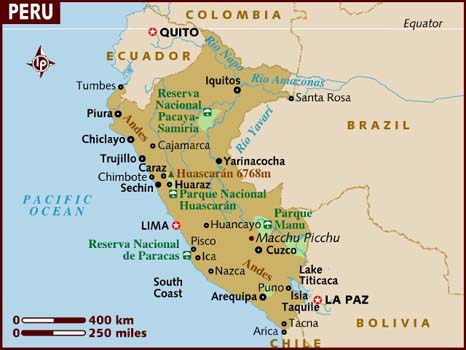
Cities/towns visited –  Lima, Cuzco, Ollantaytambo, Aguas Calientes, Pisac, Arequipa, San Juan De Chuccho, Sangalle

Number of different lodgings – 8

Flights – 1

Local bus journeys – 20

Combi/collective/taxi  journeys – 11

Long distance bus journeys – 2

Days of rain – 2

Weddings attended – 1

Antibiotics needed – 1 round each (sinus infections)

Moving Box Bet – Anticuchos

The Budget

*Air travel is not included in this budget*
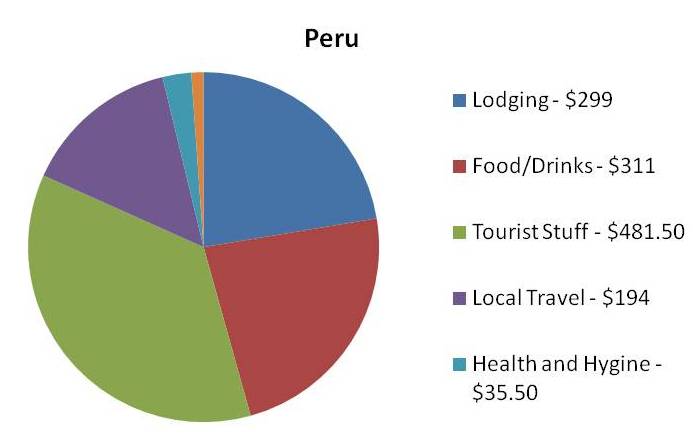
Total US dollar amount spent – $1,335.93

Average cost per day, per person – $35.16

Average lodging cost per night – $15.73

– We stayed entirely in hostels with a private room, often with a private bath. On our last night we stayed in a dorm in Lima, but we were the only ones in that room, so it was essentially private.

Most expensive lodging – $25.90 Hitchhiker’s Hostel, Lima

Least expensive lodging – $5.51 Rivelino House, San Juan De Chuccho (Colca Canyon)

Average food/drink cost per day (per person) – $8.18

* Generally, breakfast was provided by the hostels.  We often self-catered lunch by going to the markets, or went out for a set menu.  We ate out for every dinner.  We consumed very little beer and wine, mostly because we were hiking regularly so we weren’t going out to bars much.

The Best

Accommodation –  Estela de Oro in Arequipa.  Another traveller told us about this gem of a place, and it was easily the best of our time in Peru.  It’s really more a hotel than a hostel as the rooms are huge, all with private bath,  flat screen television, and great internet access.  The rooms come with lovely fluffy towels, little bars of soap, and a pretty standard breakfast of tea/coffee, rolls and jam.  We paid only 50 soles a night, which was a HUGE bargain considering the comfort level.
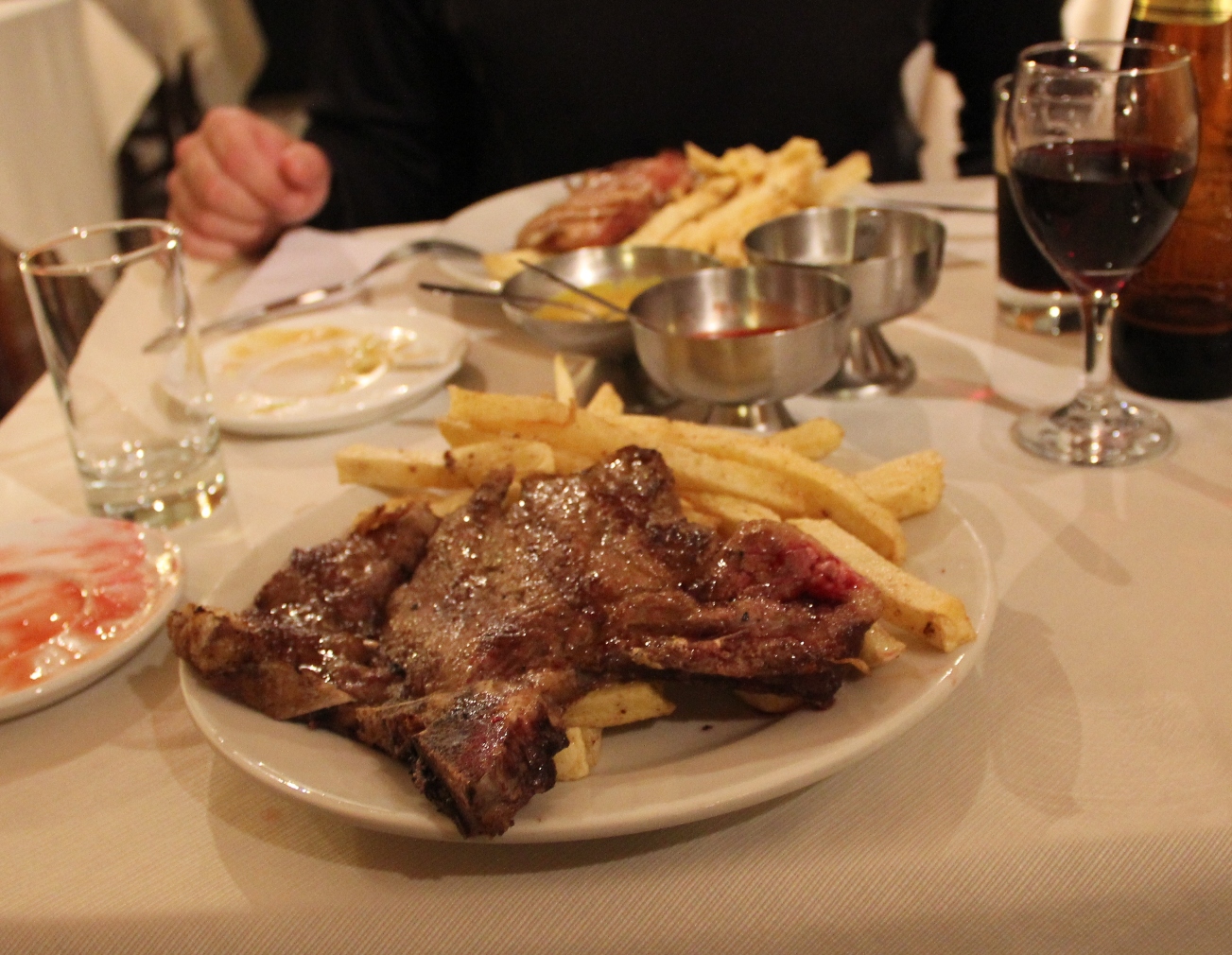
Huge, delicious steaks.

FoodRasa Nostra, also in Arequipa, and only for meat lovers.  Rasa Nostra is located on Bolognesi, between Sucre and the Plaza de Armas (and right around the corner from our favorite hostel).  They have incredible set menus for dinner, most of which involve a colossal amount of Argentine-style grilled meat (think perfectly cooked steaks, chorizo, etc), french fries, and a salad bar.  A full meal was about 15 soles, more than we’d paid generally, but a total steal for the amount and quality of the food.  The restaurant itself is quite nice, and was packed for both lunch (when they have a cheaper set menu that is more traditional with a soup, entrée, and drink) and dinner.

Empanadas at the market in Arequipa.  Clearly Arequipa treated us well.  If you head over to the main market, there is an empanadas stand just inside the center entrance.  They were the best empanadas we had in all of Peru, especially the chorizo ones.

Prasada in Cuzco.  Prasada serves up delicious vegetarian dishes, including a mean falafel sandwich.  They also make great fruit smoothies.  You can find Prasada on Choquechaka, near San Blas.

The Worst

Accommodation

Hostel Joe in Aquas Calientes.  Based on the review in Lonely Planet, we expected this place to be basic, but tolerable.  In reality, it was awful.  Filthy hallways, questionable sheets, and a definitely sewage-like odor.  Do yourself a favor, pay a little more and stay somewhere that understands the basics of sanitation.

Oasis Paraiso in Sangalle (the ‘Oasis’ in Colca Canyon) – This is one of the more expensive places to stay in Sangalle, and clearly it has seen better days.  The rooms/huts are in various stages of tolerable, the bathrooms leave much to be desired, the bar area is literally falling apart.  The pool was ok, and the staff was nice enough, but not nice enough to make up for the condition of the place.  It looks good when you enter (lovely gardens, all the trees, the pool, etc) and it took us a little while to realize how run down it really was.  There are at least 4 places to choose from in this village, so even if you’re exhausted, suck it up and keep moving.

Packing List Part 1- Clothing

27 Dec

We FINALLY got around to putting up the first part of our packing list – Clothing.
In the months before we left I spent hours looking at packing lists from all kinds of RTW trippers, and even more hours making, then re-making my own list.

So far we’re fairly happy with the clothes we brought, and have worn everything at least once, with the exception of some of the colder weather gear that we’ll more likely use as we make our way further south.

We’re working on setting up the rest of the gear posts – medical kit, tech gear, and everything else – so check back often to the “Things We Carry” link at the top of the page.

Merry Christmas!

25 Dec

On the path to the San Francisco glacier

We spent Christmas Eve hiking up in the Cajon Del Maipo (more about that in a future post) and grilling up another delicious steak.

Incidentally, I discovered where Santiago has been hiding its Christmas Spirit.  It was alive and well all along at an enormous mall in Las Condes.   I made a mad dash there late on the 23rd in an attempt to replace the fleece that I lost in Valpariaso, and the instant I entered the doors I was awash in the sparkling lights, heaps of cotton snow, and holiday consumerism that is typical of home.

I managed to get my fleece and get out without being sucked in by the appropriately extravagant window displays, which seemed to scream “Ashley! You totally need a new summer dress!!!”.  I did, however, stick around long enough to see Santa in his rightful place – a giant throne, surrounded by lovely elves in very short skirts.

On the walk back to the subway I cranked up the Christmas mix on my iPod, and the irony of listening to “Baby It’s Cold Outside” while wondering if I had applied enough sunscreen to prevent yet another sunburn, did not escape me.

Feliz Navidad?

23 Dec

In the USA, decorating for the holidays starts so early that you have to be living under a rock somewhere to not realize what time of year it is.  Cities have begun to put decorations on public streets earlier and earlier, while holiday music creeps into the background before the first snowfall in the northern states.

I am a true Colorado girl and it takes a certain mix of signals, including snow, egg nog and lots of blinking lights, to really get me in the Christmas spirit.  Here in Santiago?  Well, let’s just say I keep forgetting it’s even December.

First off, there’s blazing sunshine and sweltering heat every day.

Christmas spirit in the Santiago cemetery

Second, there are no trees.  Christmas trees I mean.  Even in NYC there were makeshift stands lined up along the Avenues starting as early as mid-November.  Practically anywhere with a small patch of floor space, be it an office building lobby, the supermarket, or the deli on the corner of 16th and 6th Ave, would have a tree up no later than the first week of December.  Interestingly enough, we saw quite a few miniature trees all decorated up during our trip to the main cemetery here in Santiago earlier this week.

Third, the traditional decorations are few and far between.  I’m used to seeing storefronts dripping with tinsel, lights and elaborate window displays. Storefronts that demand you spend your precious holiday dollars with them because they have exactly what you need and you can’t get it anywhere else.  Here? Well, every once in a while we see a paper Santa face (circa 1976) hung in a window.  In Valparaiso we were eating in a little restaurant and it took us the better part of an hour to notice the one solitary Christmas bulb hanging by a pathetic strand of garland at the top of the window.

I don’t mean to say there is NO holiday spirit to be seen in Santiago, I mean Chile is officially a Catholic country and Christmas is a national holiday here.  We have seen wrapping paper for sale in a few places, there was a display of decorations available for purchase at a local market, and we heard the Spanish version of ‘Walking in a Winter Wonderland’ at the supermarket a week ago.  It’s just that our senses haven’t been assaulted with holiday cheer like they would be at home.

We have, however, seen Santa in a few surprising places.

Santa decorations were spotted in Lima, Peru at the very beginning of November!

It's too hot for reindeer in Valparaiso, so Santa rides the boat like the rest of us.

The economic downturn has apparently extended it's reach to the North Pole as evidenced by the fact that Santa is moonlighting with Groupon to help pad his income.

How will we be spending our Christmas?  Since most everything will be closed, we’ll be cooking at home (helllloooo grilled pork tenderloin with homemade mango and apple chutney…and this, recipe is at the end of the post), sampling a traditional Chilean holiday drink called Cola de Mono (kind of like a White Russian, or a Mudslide), skyping with family, and watching the season finale of Dexter online.

Happy Holidays, wherever you may be!

6 Lessons From The First 6 Weeks

18 Dec

Traveling is perhaps the best teaching tool there is.  Here’s a smattering of some of things we’ve learned, or re-learned, since the start of our journey.

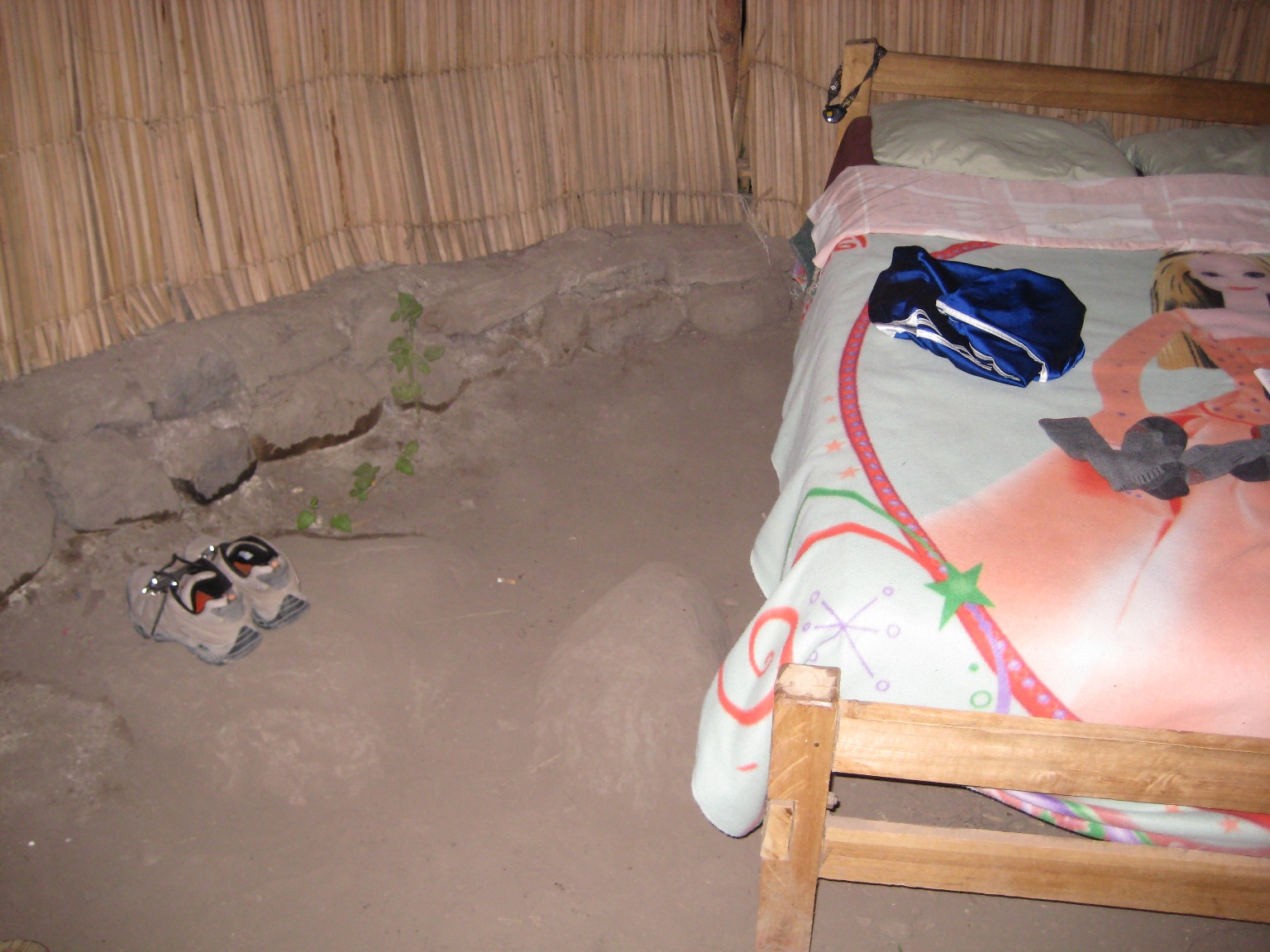
We took this room after a full day of hiking and only after we'd had a chance to rest did we realize there was a dirt floor...

1) Don’t settle for a bad room/bad price just because you are tired.  This is a lesson we’ve had many times before, but it can be a difficult one to remember in the moment.  After an 18 hour bus ride, a grueling hike, or 45 minutes looking at possible hostels, it’s tempting to just give in and take whatever you are offered – be that a rip-off taxi fare, or a room with questionable bed sheets.  It’s easy to beat yourself up later with “should have” or “could have” scenarios, so to avoid those altogether just give yourself a break, literally.  Take 5 minutes to sit down somewhere and regroup before you delve back into the negotiations.  Do you really not have the energy to go any further or to play the haggling game?  If not, then take what you can get, and chalk it up to necessity.

2) Find the local markets.  If you’ll be in one spot for a few days, it’s a great idea to find the local produce markets.  Typically you’ll be able to get a huge variety of fresh fruits, breads, cheeses and meat at a huge discount compared to most grocery stores.  In addition to general supplies, most markets have food stalls where you can get a meal or snack for only a few dollars.  It’s a great way to save some cash and interact with the locals.

By Orin Zebest on Flickr

3) Organize your photos regularly.  It’s easier than you think to rack up thousands of photos over the course of a few weeks.  If left unattended it can take hours of tediously going through pictures, deleting the ones you don’t want, and trying to figure out where each one was taken.  Sitting down to organize them regularly will help you tame this beast of a chore.

4) Starbucks and KFC always have clean, free bathrooms. It may be abrasive to see so many chain businesses popping up abroad, but there are a few positives to this phenomenon.  Not only does Starbucks always have free, clean bathrooms, but you can also wait around for your night bus in a much more comfortable spot than the floor of the local station.  As a bonus you don’t even have to buy anything to while away the evening on one of their couches.

By javajoba on Flickr

5) “Travel Size” doesn’t always cut it.  When we started making our packing lists,  we had to focus a lot on how to save space or weight in our packs.  The first inclination was to bring all our toiletries in travel size.  This has worked out well for some things (the miniature brush for example) but not for others.  Tiny containers might be fine for a few weeks, but for long-term travel it just doesn’t make sense to have everything in such small quantities.  That doesn’t mean you need to buy in bulk either, but for our daily use items like sunscreen and toothpaste, we just carry around a normal size container and they don’t add enough bulk or weight to our bags to be a problem.

By Spec-ta-cles on Flickr

6) Make time for “normal”.  Long term travel is not just a huge extended vacation.  Ok, maybe it is, but it’s also your life.  You need things like shampoo and kleenex, or a day to just run errands or have some down time.  Make a point to take a day to rest here and there.  Get your laundry done.  Restock your personal supplies.  Sometimes it’s the little things that make you feel like a regular person again, instead of like a manic tourist.

Feeling the Love in Ollantaytambo

13 Dec

Ollantaytambo, Peru

We intended to spend just one, or maybe two days in Ollantaytambo.

The thing about intentions is that you never really know where you might end up if you let them run off course.

On our way back from Machu Picchu we decided to stop over in this little village – there are more ruins there and I have a vague recollection about it being one of the places where the Inca really held out on a battle against the Spanish.  In any case, those ruins are included in the tourist boleto and we were hell-bent to get our money’s worth on that particular purchase.

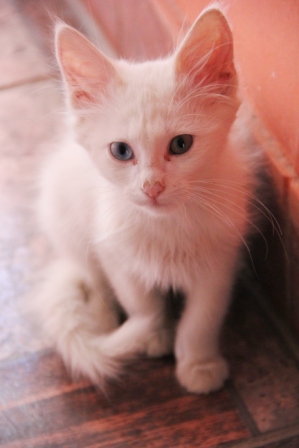
"I can haz snuggles?"

We chose our hostel based entirely on the fact that the write-up said they had cats, and we really miss our own kitties.  It was as simple as that.

We arrived exhausted after getting up at 5 am and tromping around in the scorching heat all day, so we were a little disoriented when we walked into the common area and found a group of people popping champagne and the hostel owner scurrying around with bags of groceries and packages of flowers.

We had walked into a pre-wedding celebration.  The hostel owner’s sister was to be married the next day, and she was frantically trying to finish preparing for the festivities.

Recalling the insanity that was the night before our own wedding, we asked if there was anything we could do to help.  It didn’t take long before we found ourselves chopping carrots, peeling garlic, arranging flowers, hanging garland and moving tables and chairs around.

Flowers dry in the sun

By the next morning, we had been invited to attend the two-day celebration.  We were told to be ready to go at 9.

Good thing the groom has a sense of humor...

Apparently the bride has a long history of being late, and this day was no exception.  As we waited, we got the opportunity to get to know the groom and his family (from Germany) and receive our traditional decoration to wear to the first ceremony, which was really a two-for-one with a civil service and the traditional shaman ceremony.

Justin gets some traditional flair

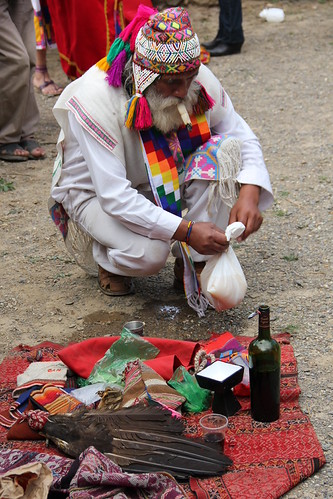
To begin the traditional ceremony, the wedding party and guests paraded through town, following the Shaman who spent the better part of the 20 minute walk blowing on a conch shell to alert our presence to everyone in the area.

We wound our way through town, over a fence, into a horse meadow, past some crops, over an irrigation ditch and into a cornfield.

There are small ruins scattered all through the Sacred Valley, many of which are never seen by tourists as they are too small or are located in someone’s field.  I can’t think of a more stunning place to be married.

The ceremony was long (3 hours), and at times, intense.  We didn’t understand most of what the shaman was saying, but overall we got the gist of what was happening.

Unlike most weddings we’ve been to, the ceremony involved a lot of guest participation, especially with the parents.

At one point the men and women were separated and sent into different areas.  We gathered in our circles, the women with the bride and the men with the groom.  We were given some kind of herbs to smoke (not those kind of herbs…) and as we each took a puff, we were asked to give some words of wisdom, advice, or support to the bride and groom.  It was an interesting mix of thoughts, given in German, Spanish, and English and was mostly about marriage and love, but also about staying true to yourself and finding support when you need it.

Mom and sister give advice to the bride.

Something we found very interesting was that during the “I do” part of the ceremony, the bride and groom told each other not only what they liked about their partner, but also what they didn’t like.  People we have spoken to about this ceremony are often confused as to why we would be so drawn to this part since the general consensus seems to be that you shouldn’t be telling your loved one what you don’t like about them, especially at your wedding.

Let’s be real here.  People don’t typically love everything about their partners.  The thing about marriage is that if you go into it thinking everything is going to be perfect and that love conquers all, well, you’re in for a hell of a surprise.  Marriage is a partnership and, like all partnerships, there will be times when the partners don’t agree.  Love, in and of itself, doesn’t solve problems.  People solve problems.  What drew me to that portion in the ceremony was the fact that it was so honest.  They were saying that they loved each other for all the ways that the other person is so wonderful AND that they loved each other in spite of whatever imperfections they might have.   They were really committing, openly and clearly, to their partner as a whole person.

Near then end of the ceremony a young girl came running up with a plastic bag filled with fresh milk.  The parents of both the bride and the groom took turns tossing cups of wine, and this milk, to the four directions.  Afterwards, the bride and groom took turns pouring the rest of the wine and each guest drank from the same cup.

Justin partakes of some ceremonial wine

After it was all said and done, we headed back to the hostel for the first night of the fiesta and a huge homemade meal.

The next day was the traditional Christian ceremony and large reception.  It was held a few kilometers outside of town at Tulupa, a restaurant in yet another stunning little valley.

Tunupa Restaurant in the Sacred Valley

The ceremony was lovely, the food was excellent, and the pisco never stopped flowing.

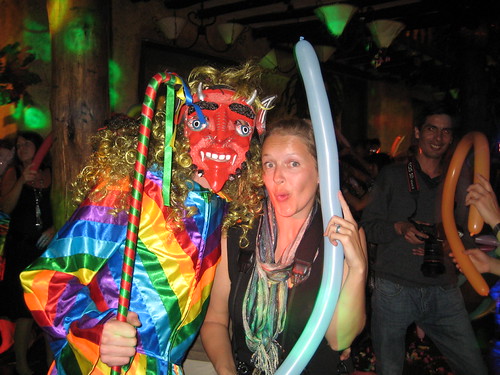
Like most events where people have been drinking and dancing for 6+ hours, there came a point when the crowd started to get tired and began to take a break from the dancing.  There is a way to stop this.  It’s called “Crazy Hour” and it involves scary clowns with balloons, masks, bizarre hats, confetti, foam (yes, foam) and a serious dose of dance music.  Within seconds everyone, and I mean EVERYONE was back on the floor whooping it back up.  Amazing.

Exhausted, happy, and very drunk we finally piled into a minivan, with the groom’s family and friends, to be carted home sometime in the wee hours of the morning.   The journey may or may not have included rambunctious group singing of various American rock classics, and a rousing chorus of Mein Hut Der Hat Drei Ecken…the only German song I know all the words to.

When we started out on our adventure around the globe we left our itinerary wide open, knowing that we wanted to be available to take advantage of whatever the universe might present for us…for example, a random invite to an incredible wedding.

For more pictures, check out the slide show:

The Ancient Marvels of Monasterio de San Francisco

10 Dec

Monasterio de San Francisco

We’ve seen a lot of churches, temples, monasteries and other places of religious importance throughout our travels.  They make great tourist spots for a number of obvious reasons (art, architectural beauty, cultural significance  historical significance, I could go on and on here…).  The thing about churches is that after a while, if you’ve been travelling and seeing dozens of them in a very short time period, they all start to blur together.

If you find that happening to you in Lima, but you still want to go out and see the sights, I highly recommend the Monasterio de San Francisco.  It’s included in every guidebook’s section about downtown Lima, but if you have only a day or two in the city I could see this one getting lost in the shuffle.

The structure in and of itself is nice, there are many rooms that hold lovely pieces of art, or very old furnishings, but there are two things that make this place stand out above some of the other smaller sites we’ve visited.

1 – The Library

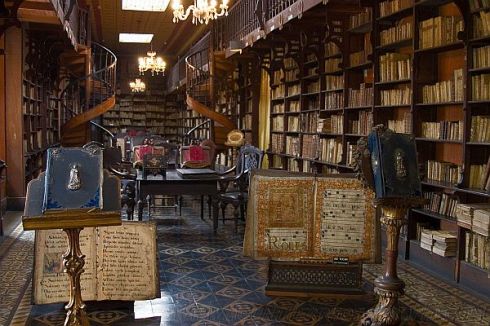
Now, I have to admit to having an affinity for books and other old things (I was a history teacher…old things are awesome), but this was truly amazing.  The monastery has a library collection that contains 25,000 ancient texts, most of which are handwritten, and some of which date back to before the Spanish conquest!  The room itself is beautiful, and they have a few enormous books on display right up next to the ropes that keep you from actually entering the room.   You can really feel that you are in the presence of something magnificent here, and I would have stayed for hours if we had been allowed.

Library at the Monaserio de San Francisco. Photo by Andre Gunther Photography.

 2 – The Catacombs

Catacombs aren’t for everyone.  Before we entered we were told by our guide that if we felt nauseous, or uncomfortable that we should leave and wait by the exit for the rest of the group to join back up.  We’ve seen some smaller catacombs, but we were simply not prepared for how massive this site is.  Apparently, it was the general burial area for hundreds of years, for everyone in Lima.  Our guide estimated that there were more than 70,000 skeletons that had been unearthed so far.  That’s right, only so far. They had rearranged the bones into separate earthen bins, which were open and just inches away from the walkway.  We passed bin, after bin, after bin, after bin until we finally came to the end of the tour, where a giant well of sorts had been used to arrange skulls and more bones into a morbid circular display.  It was both extremely unsettling, yet completely fascinating.  I find myself wondering who these people were?  Is this how they are to be remembered?

Catacombs of Monastario de San Francisco taken by Ray_from_LA on Flickr

It’s only a few blocks away from the Plaza de Armas, so it’s quite easy to get to if you are already in the center.  You  must pay a small entrance fee of 7 Soles, but this includes a guided tour of about an hour in Spanish or English.  Most people we’ve met along the way have skipped this particular site, so we’re here to encourage you to go!

The Moving Box Bet – Chile

5 Dec

Justin’s first Moving Box Bet challenge in Peru was pretty easy.   So easy that even I participated.  We decided to crank it up a notch for the Chilean challenge, and crank it up we did.

Take a look:

Video not showing up?  Try this –  Moving Box Bet – Chile

Justin’s next Moving Box Bet challenge will take place in Argentina.  Contact us if you have a suggestion for what he should eat!

30 Days

2 Dec

We’ve been on the road for 30 days.

I sort of can’t even believe it.  On one hand, it still feels like we’re just on “vacation”.  On the other hand, it feels like we’ve been gone for a lifetime.

Peru was a whirlwind, we were so busy doing things because we knew we had only a short time to be there and we didn’t want to waste a single minute.  After nearly three weeks of moving at the speed of light, we felt like we had been on the road for months.

Chile has so far been extremely mellow by comparison.  We have some great friends here who we’ve been staying with and we’ve had the chance to slow down and just be ‘normal’ for the past week.  We’ve done laundry, gone grocery shopping, started running again, and haven’t felt much like tourists at all…except for that whole not being able to communicate very well in Spanish bit.

It’s OK though, we have plenty of time for sightseeing because we’ll be staying in Santiago for another month.  We start an intensive Spanish class on Monday, Justin may complete his next Moving Box Bet Challenge as early as this weekend (it’s a good one, stay tuned!), and there are loads of little day and weekend trips in the works…hello wine tours!

(Inexplicably, the slideshow isn’t working for everyone.  Go ahead and click the link instead if you can’t see the embedded version.  If you hover over the slide show, you can expand it to full screen using the link at the very bottom of the black border.  To see the captions once in full-screen mode you can click “show info” in the upper right corner.  Hate this slide show format? I do.  Have a better one in mind?  Let me know!)

http://www.flickr.com//photos/theparallellife/sets/72157628247374035/show/

Even after 30 days it’s clear that we’ve only just begun, and we can’t wait to see what’s in store for us this month.