
**UPDATE (March 2018) – We still get loads of hits on this particular post, which leads me to believe that guidebooks still aren’t giving great directions on how to do this (get it together guidebooks!). There are a number of readers who have written posts of their own with updated pricing etc – you can find links to those in the comments, or the section below the comments (Trackbacks/Pingbacks). We would highly encourage you to check those out as well to see what’s changed since this was originally posted.**
Really, the only reason we went to Arequipa was to hike the Colca Canyon. Originally it was going to be our test hike to see how well Justin’s leg might hold up on the Inca Trail (he had a muscle tear, no fun), but even after we decided not to trek to Machu Picchu, we still wanted to take this hike. Why? Well, partly because it’s billed as the world’s second deepest canyon, and partly because we didn’t hike the Inca Trail, so I was bound and determined to hike SOMETHING for more than one day in Peru.
Colca Canyon is a big tourist destination, and as such, there are about a million different tours or trekking packages available from every single “travel agency” or hostel in Arequipa.
Lonely Planet suggests that you can do the trip yourself. Unfortunately, the edition we have doesn’t give a whole lot of info about how exactly you do that, and I am not the kind of person who feels comfortable setting out on 3 day hiking trip without some fairly solid details, or at least a decent map. After searching around quite a bit online (tons of people have done the trek alone and posted basic itineraries), and pestering the moderatly helpful agents at the tourist info booth in Arequipa, and then asking around a bit at Cabanaconde, we managed to figure it out. However, it would have saved a whole lot of time and quite a bit of stress to have found some detailed instructions somewhere. To that effect, I present –
How To Hike Colca Canyon Without A Guide.
This is long…if you don’t plan on hiking the Colca Canyon, you could just stop here and check out the slideshow:
*Disclaimer – I am just a regular person, writing about MY experience. I hope you find this helpful, but it certainly shouldn’t be your only source of info. Please ask around before you head out to make sure things haven’t changed, and obviously, use your own common sense.*1) You need to get yourself to Cabanaconde, where the hike begins. This is about a 6 hour bus ride away from Arequipa. There are a number of bus companies that go there including Andalucia, Milagros, and Transjesa. The booths seem to be clustered on an island in the center of the central bus station rather than around the edge like the long-distance companies. You can buy tickets from a travel agent, but they will charge you an outrageous commission. We opted to take a combi to the main bus station (Terrestre) and just buy one way tickets the day before we left. Most combis seems to go there, ask around as to where to catch one near where you are staying.
Cost: 16 soles one way.
2) If you want to avoid spending a night in Chivay or Cabanaconde you can take an early morning bus to Cabanaconde – they seem to go around 1am, 3am, 5am, 6am and hike all the way down the same day. We took the 6 am, which got us in around noon. We had time for lunch, and then had no problems hiking down to our first destination that same day. Taking the 1 or 3 am bus seems masochistic. The reason people do it is to stop at the Condor viewing overlook when the birds are supposedly most active. We aren’t really into birds, so we didn’t care about that, but I will say we saw one from the bus, and many while hiking so unless you are REALLY a birder, choose sleep and go with the 5 or 6 am bus. It also seemed like if you got off the bus at the viewing spot, you’d be stuck there for at least another hour until the next bus came along. If you’d rather hike in the morning, you can stay at either Chivay (about 3 or 4 hours into the bus ride from Arequipa there is a stop at this town, they apparently have a hot springs and places to stay) or at Cabanaconde. If you go during high season it might be worth making reservations somewhere in advance, but it seemed utterly dead mid-November.
3) At some point you will have to buy the tourist boleto. People in the past have argued that this is a scam, but you really do need to buy one, just like you do in the Cuzco area. We got ours in Chivay while the bus was reloading, but we could have bought one in Cabanaconde as well. Officials with green or beige vests and clipboards have them for sale, and you have to buy one, there is no way around this. They are square, and MAKE SURE they have a rectangular tear-off section attached for “control” at the end of the hike. Ours got lost along the way and we nearly had to pay again.
Cost: 35 Soles per ticket.
4) We tried with diligence to find a trail map. We could not. We found a few rough maps online that people had scanned, and those turned out to be the same at ones that were given to us by hostel touts upon exiting the bus at Cabanaconde. There seems to not be anything better, and we did just fine with these, so I imagine unless you really get off track, you should be ok. There are two different basic maps, with estimated times, but they are NOT to scale and NOT technical. Here is one, and here is another.
5) To get to the trail depends on which route you take. We wanted to hike down to San Juan de Chuccho the first night, then onto Sangalle the second day, and then back up to Cabanaconde. If you want, you can just head straight down to Sangelle one day, and back up the next. If you are in good shape you could do it all in one day as it apparently only takes about 2 hours to get down that trail, and it took us 4 hours to hike back up.

This sign shows the way to Sangalle, but it marked the finale of our journey as we headed back into the main Plaza.
To Sangalle – follow the gigantic sign just off the main plaza by the Hostel Valle Del Fuego. It points you in the correct direction, which leads down a street (no turns, just stay on that road) and eventually into a cornfield where you follow a rough path that ends up on a trail that really looks like a ditch, where you will turn left. The ditch leads you directly to the proper trailhead and a control checkpoint where you will have to show your boletto. You will likely doubt that you are on the right path, but we saw a number of hiker groups on that path on our way out, and you can always stop and ask a local if you’re headed the right direction.

The trailhead to get to San Juan de Chuccho
To San Juan de Chuccho– Facing the church in the main plaza, go down the road that runs along the left side of the church. After about 3 blocks you need to turn left onto a street that is ‘more’ paved with stones than with dirt, and after a few more blocks you will end up on an actual paved road, which is the one the bus comes in on. After about 10-15 minutes you should pass a large football stadium on your left, and shortly after you will be at the overlook Mirador de San Miguel where there is an actual trailhead sign.
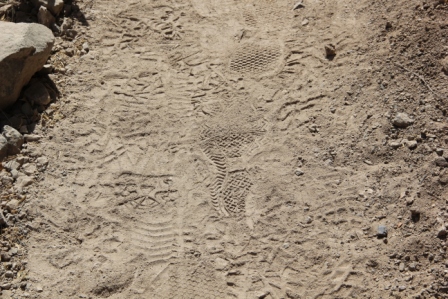
Hiker footprints *generally* mean you are on the right path.
6) Stay on the main path. Do not take shortcuts. Shortcuts increase erosion, and the place is slippery and rocky as is, so don’t encourage any more small landslides! When you come to a fork, take the bigger path. If you see a lot of hiker footprints, you are probably on the correct path. There are not many forks, and when there was, there was always a very obvious ‘main’ path.
7) It took us about 2.5 hours to get all the way down to the bottom where there is a little bridge you have to cross. We had to show our boletos here as well.
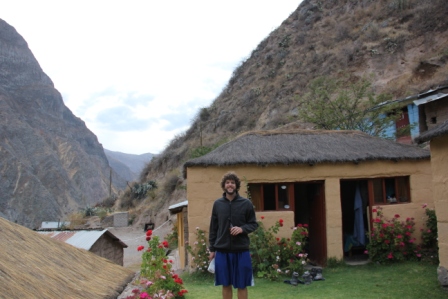
Justin outside our Rivelino house accommodations.
8) There was a woman waiting at the bridge who took us to the Rivelino’s House in San Juan de Chuccho where we spent our first night. There is another place to stay in this village, Roy’s House. If nobody is at the bridge waiting to take you somewhere, you can take either path leading to the village (there are two, apparently they go to the same place, the lower path is very steep for a short bit, but is quicker. The upper path meanders a little, and thus takes a little longer). There were directional arrows and signs painted on big rocks along the trail that would lead you to either Roy’s or the Rivelino’s house.
We thoroughly enjoyed staying at the Rivelino’s House. They had a number of huts/rooms that were basic, but clean. There were hot water showers, flushing toilets, and a little store with beer, water, tp, some candy, etc. They also served a basic but filling dinner (I believe we had beef, some veggies and rice, if you are vegetarian you might just get pasta). The next day we had a lovely breakfast of banana crepes drizzled with caramel.
We were the only people there without a guide, and we seemed to get the exact same service/meals that everyone else did, with the exception of dinner. We were the only people to get meat. I can’t imagine that everyone else (maybe 15 people) were vegetarians, so I suspect it’s just what the guided groups either carried in or contracted to pay for since it’s easier to serve a batch of spaghetti than to cook 15 steaks.
Cost : room was 8 soles per person
dinner was 8 soles per person
breakfast was 5 soles per person.
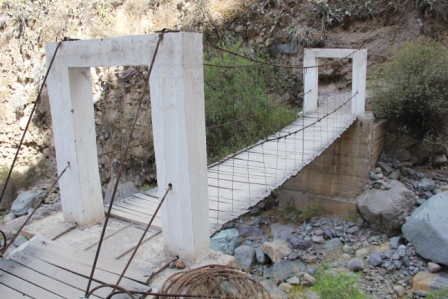
Did you get to this bridge? Then you are going the right way!
9) The next day we were up early and on the trail by around 8. To get to Sangalle you have to go through two small villages – Cosnirhua and Malata. You can alternatively head out to Tapay, which we didn’t do, and then loop back around. The locals pointed us in the right direction, and we just followed the path around the side of the canyon, and eventually down to the bottom again where we had to cross another small bridge. I was worried we would accidentally take the turn-off to Tapay but we didn’t, and in fact I’m not really sure where the turn off is so if you want to go that route, I suggest you just ask before you are out of San Juan de Chuccho. It took us around 30 minutes to reach the bridge, and then it’s uphill for around 45 minutes to the town of Cosnirhua.
10) Once at the edge of the town of Cosnirhua there are two paths you can take. The one headed left will take you on the edge of town, the one leading the right will take you through the town, but they meet up again at the end of the village.
11) It takes about 20 minutes to walk between Cosnirhua and Malata, and it was flat and easy.
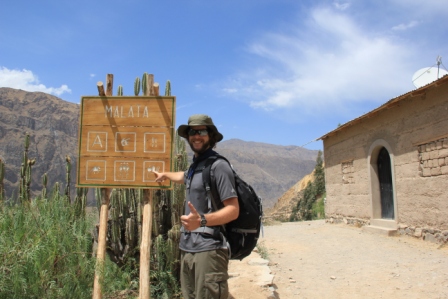
Justin is excited that we can find beer in this little village.
12) In Malata there is a hostel with a little store and a museum. All the tourist groups stop here and are served the fermented corn beer (which seemed warm and terrible) and are given a little red smudge on their faces from the cactus. As we had already played with the cactus smudges on the trail, I didn’t really feel like we were missing out. The store has all the basics, pasta, soup packets, rice, soda, water and beer. The beer apparently used to be only 5 soles, but it’s now 10, so you’d be better off just waiting until Sangalle.
13) From Malata the trail continues very obviously down to Sangalle, it took a little less than an hour for us to get down there.

The pool at our hostel in Sangalle
14) Sangalle is odd because it’s not really a town, just a series of little resorts. There are at least 4, and I strongly suggest you look around before you accept a room. We made the mistake of being lazy and just saying yes at the first place we came across in Sangalle, Oasis Parisio, which apparently used to be quite nice, but is now a total shithole a bit rundown. Our hut was tolerable, but had dirt floors, and we heard afterwards that the two places beyond it are newer and have tile. The whole ‘resort’ is in a bit of shambles, and I wish we had just sucked it up and found our way to the next place. Unfortunately it rained most of the afternoon that we arrived so we only got to enjoy the pool for a little while.
Cost: 10 soles per person for a room, unless you get a matrimonial (double bed) and then it’s 25.
10 soles per person for dinner – soup and pasta.
They also serve breakfast (7 soles) and lunch (10 soles) but we didn’t partake. We just bought a few bananas the next morning to supplement the bread and granola bars we brought with us.
15) To hike back up was very obvious…you just go straight up. It’s mostly switchbacks, and there were no real splits to confuse you. Hiking times vary greatly…we did it in four hours. Some English guys that were also staying at the Oasis made it in about 3hrs 15 min, and there were a few other guys who claimed to have done it in just over 2. If you are in great shape and acclimated to the altitude I’d say between 2-3 hours is reasonable. If you are in terrible shape, give yourself 5+ hours. The average seems to be 3-4 hours.

A much needed rest about halfway up.
We started around 6:30am to try to avoid some sun, which was a good idea as there are no trees or shade other than the sides of the canyon before the sun is up. After about 2 hours we had reached this little overlook with a little hut and a place to sit.
If you just can’t (or don’t want to ) hike back up, you can hire a mule from every hostel in Sangalle. We didn’t do this so I can’t speak to the actual cost, but Lonely Planet puts it at around 60 Soles.
16) At the top there was a control guard who needed the tear off pieces from our boletos that we didn’t have. We got lucky and he eventually let us pass without it, but we were a bit nervous that we were going to have to pay a fine or something.
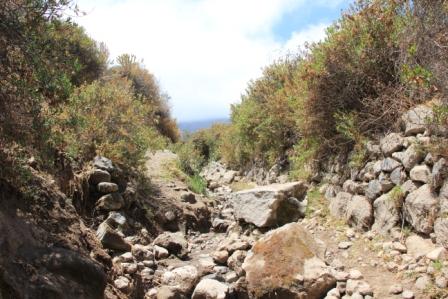
I swear this is the trail. Ok, it might ALSO be a ditch, but it really is the trail.
17) Once at the very top you follow the path into something that looks like a ditch (you will probably be thinking “no way is this the right way…”), then when you see the cornfields you go over the small wall to your right onto the path through the corn and follow that into the town and right onto the road that has the Hostel Valle Del Fuego and onto the main plaza.
18) You can buy your bus tickets when you get back (might be a good idea in high season to do this before you hike down, just make sure to be back up in time!). The bus times change frequently, but we caught one at 11:30 headed back to Arequipa.
Cost: 16 soles one way
Our total cost per person for the whole three days (including all water, some beer, food that we brought as well as meals in the canyon, lodging, transportation and entrance tickets): 140 soles per person
Did we save a ton over the tours?
No, but most tours didn’t include the boleto though, so without that we did cut the cost by at least 1/3. Prices seemed to land around 150 Soles for some type of 3 day package, though what you get for that 150 varies. Some tours offer no hiking at all, they merely cart you to a number of spots on the rim of the canyon to see the condors and to marvel at the depth of the valley, others take you to scenic overlooks, spend the night in Cabanoconde or Chivay and then have you trek down to Sangalle (the oasis) on the second day, and trek you out on the third. Yet others offer a solid three days of hiking where you get to spend 2 nights in the valley, usually one in a village and the other in Sangalle. If you’re looking at a tour, make sure you know exactly what the itinerary is as well as what’s included – will they provide all the meals? Snacks? All the water? One thing most companies don’t include in the cost of their trip is the tourist boletto that MUST be purchased in order to enter most villages in the area, including Cabanaconde. As of November 2011, it was 35 Soles, but rumor has it that price is about to double.
Incidentally, Lonely Planet’s suggestion of the company Colca Trek, seems totally out of whack for the otherwise budget friendly guide. Colca Trek quoted us 690 soles for a 3 day tour that included one night of camping at the oasis, and one night at the top of the canyon. The stopped at a number of places along the way to look at the vicuña and some natural landscapes as well. It may well be one of the better tours in the area, but the price just about blew us out of the water.
Would we have rather taken a tour considering how close the cost was?
No. It was nice to be able to do things at our leisure, and not feel like we were being rushed, or having to wait on people. It also was really easy to do on our own. If you don’t hike much in your day-to-day life, or just want to have the added comfort of going with someone experienced, then I’d recommend a tour. Just make sure you shop around and are very sure what exactly is included before you put any money down.
What did we bring with us?
One outfit to hike in – we wore it each day for 3 days (with new socks and personals each day)
One outfit to sleep in
Sleep sacks (which we didn’t need)
Swimsuit for Sangalle
Lightweight towel
Two giant (2L, heavy but necessary) bottles of water (bought a third in the canyon)
A few bananas, 6 granola bars, 2 chocolate bars, and 4 rolls. The rest of our meals we bought at the hostels or had en route in Cabanaconde
Headlamps – a must, most places in the canyon do not have electricity.
Flip flops
Warm fleece for night, it gets COLD.
Hats with brims
Sunscreen and bug spray. There is no shade, you will get fried. There are also these little flies that bite in Sangalle, highly irritating.
Basic first aid kit with advil, band-aids, sports tape, dehydration salts, anti-bac, immodium and water treatment tablets.
Rain jackets
All the money we needed for the whole time as there are no ATMs in the canyon. Bring small bills.


 The Parallel Life