The Nepal Curveball

5 Sep

We went to Nepal to get away from the cities and the pollution and the general chaos of constant travel.  We knew that hiking the Annapurna Circuit would be both challenging and rewarding, and our entire trip to this lovely country revolved around the hike.  That is, until I got sick.

We had just finished our 150 kilometer trek and we were incredibly sore, but feeling really good about successfully carrying our own gear and still making it all the way through on our original schedule.  I went to bed that night dreaming of relaxing back in Kathmandu with a giant burger and a beer.

The next morning I woke up feeling, off. It was cloudy and we suspected our flight out of Jomsom would be cancelled, but we dragged ourselves out of bed at 6am and headed to the airport anyways.  By 8am it was crystal clear that not only was the flight not going to happen, but also that I was getting sick.  I spent the next 20 hours attempting to fight off a fever and shivering uncontrollably despite being buried in both of our sleeping bags AND two huge blankets.  I figured this was my body’s way of getting back at me for all the long and punishing days of hiking.

The next morning I still felt unwell, but our flight was set to go so I rallied myself and managed to survive both the flight as well as the very long and bumpy bus ride back to Kathmandu.  I figured once I had a good shower and some clean clothes I would be feeling much better.

I was wrong.

Justin kindly took a photo of me feeling quite ill. In retrospect, I don’t look nearly as bad as I felt at this point.

I woke up in the middle of the night, feverish again, and started to worry that something was really wrong.  By the next afternoon I still had the fever and it seemed to be getting worse.  We started to think I might have gotten malaria, despite taking anti-malarial meds all through India.  Justin called the US Embassy to get a recommendation for a doctor and we were directed to the CIWEC clinic, which caters mostly to foreigners and expats.

A few hours and many vials full of blood later I was informed that I would not be going back to the hotel that day.  The good news is that I didn’t have Malaria.  The not so good news is that they thought I had Typhoid Fever, though they sent out some blood cultures just to be sure.

Typhoid Fever is typically transmitted to travelers by an infected person who does not wash up properly after using the toilet, and then prepares food.   I had gotten the vaccine but the doctor said that while it’s ok to have, it’s really not much more protection than having an umbrella with a huge hole in it during a thunderstorm.

I was started on a series of both oral and IV antibiotics and told that the fever would likely not be getting any better until the infection was cleared.  They were right. I had a raging fever, reaching 102.5 – 103 degrees most days, for a total of 10 days.  The fever was accompanied by stomach pain, a complete inability to eat more than a few bites of toast at a time, and some of the worst headaches I’ve ever had.

During one of my better moments I manage to use the hospital’s wi-fi to break up the monotony of the day.

After a few days the blood tests came back, but they were all negative.  After that I had to give blood samples every few days so that they could test for other types of bacteria and viruses, and in the meantime they added two more antibiotics to the mix just to cover all the bacterial bases.

Finally, after what seemed like an eternity in the hospital, though it was really just about a week, the fever broke and stayed away for 24 hours.  Armed with baggies full of the rest of the antibiotics, I was released from the clinic, even though there was never a definitive diagnosis as to what I had.  The medical records I was given when we left the hospital state that it was a case of “possible Typhoid” since the blood tests apparently often come back negative when up to 50% of the time they should be positive.  It’s been 5 days, I’ve finished the antibiotics, and am finally feeling more like myself again.

After all our time preparing for the Annapurna trek, it’s frustrating that we didn’t have any time to revel in the accomplishment immediately after completing the journey.  The illness came on so fast, and so strong, that it seems like that’s the only thing that happened in Nepal.  We’ve finally managed to pull the hundreds of photos of the hike off our memory cards and now we need to sit down and make a point to go through them and focus on those 12 days of struggle and success so that the better memories can rise up to the surface and overtake the blur that the fever created.

In the meantime, we are hanging out in Thailand, re-acquainting ourselves with our old friend ‘beer’, and making plans to go visit my brother, who lives a life full of awesome on a little island in the Gulf of Thailand.

Photo Friday – The Taj Mahal, India

31 Aug

The Taj Mahal is one of the worlds most well-known pieces of architecture, and seeing it in person is just as impressive as you think it will be.  We certainly took our fair share of the standard straight-on photo from the beginning of the gardens, but we also liked the views you get as you peek out massive doorways of the mosques that sit on either side of the Taj Mahal.

Photo Friday – Taking Salt Flat Photos in Bolivia

24 Aug

We’ve seen a lot of optical illusion type photos taken in the Salt Flats of Uyuni that come out terribly fuzzy, so we thought we’d share with you how we got ours to be relatively clear.

In the photo above, Bryan looks like he is about to eat Kristin.  To get a shot like this Kristin had to be far enough away from Bryan to appear small enough to sit on the spoon.  You can eyeball this and have the person in the background move as necessary.  Whoever is taking the photo needs to be down on the ground, relative to whoever is in the foreground of the shot.  From here it’s just a matter of lining them up so that she appears to be all the way on the spoon instead of just above, or below it.  In some cases it’s easier for the photographer to move, in others you can adjust the subjects slightly.

The real trick, however, is getting all the subject to be in focus.  To accomplish this we used the manual settings on our cameras, though really you just need to be able to adjust the aperture.  We set the aperture to a high number (the higher the number, the smaller the opening that lets the light in) and then let the camera set the shutter speed.  In the first photo, we had the aperture at f29, with a 1/60 shutter speed.  We took 8 or 10 photos, adjusting the focus slightly in each one until we were happy.  Sometimes it works to focus somewhere in between the subjects, other times it works better to focus on either the front or the back subject.  At this point I can’t remember what worked best in each photo, but just take loads and you’ll be sure to get at least a few that turn out.

For some, like the jumping shots with the guidebook, the photographer has to get right down onto the ground in order for the effect to work correctly.

Again, the key for us seemed to be getting the aperture at a high setting, with a slower shutter speed.  For the jump shot we used f25 with a 1/80 shutter speed.

Good luck, and don’t forget to bring some props!

Road Trip – Bolivian Salt Flats

21 Aug

*If the weather held up, we should be done with our trek and chilling out in Jomsom.  We might even be on our way back to Kathmandu!*

The salt flats in Bolivia seem to go on forever!

For a country that is quite small in comparison to some of its neighbors, Bolivia has a lot to offer in terms of travel possibilities.  There are mountains, volcanoes, jungles, lakes and deserts, and it’s relatively easy to move from one place to another.  We were intrigued by the possibilities and one of the major ‘must see’ items on our list was the famous salt flat near Uyuni.  There are a myriad of ways to visit this area, but since we were making our way up from Argentina, we chose to do a 4 day jeep tour that began in Tupiza, and ended in Uyuni.

We’d already been travelling with our friends Kristin and Bryan from Happy To Be Homeless and were planning on meeting up with another friend, Eric from Ric and Roll, in Tupiza.  It’s easy enough to cruise into town, especially with a ready-made group of 4-5 people, and book a trip leaving within a day or two. We set out early in the morning, our packs strapped to the top of our Landcruiser, ready to see some of Bolivia’s highest lakes and desert formations.

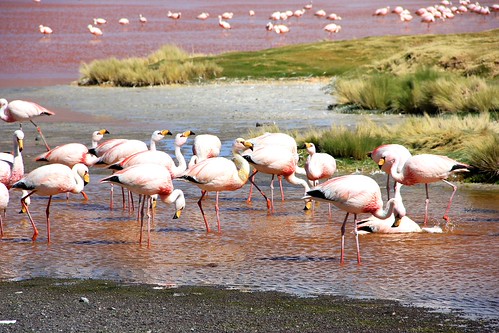
Over the next few days we drove hundreds of kilometers on roads that often weren’t really roads at all, sometimes on ledges that were terrifying, or through dry riverbeds dotted with massive rocks. We spotted small villages, huge lakes, towering volcanoes and tons of flamingos.  That’s right, flamingos.  As it turns out, something about the altitude and composition of the mineral lakes (some of which are poisonous to humans) makes a perfect habitat for flamingos, of which there are thousands.  It was fascinating to see the bright bursts of pink these birds  provided in the otherwise stark landscapes.

One stop had us soaking in a hot spring, which was especially nice after being quite cold for most of the trip.

One of the most surprising sights was the huge amount of quinoa that dotted the landscape.  It’s a colorful crop and farming it is one of the major sources of income for locals in this area.The other common income source is raising llamas, which were also quite abundant.  Many of the animals have “pierced” ears, with different color poms that serve to identify them as they wander around the plains.

At our highest point, over 5,000 meters, there were amazing sulfurous hot mud pits that boiled and gurgled like a horrible stew.  It was both terribly smelly and oddly fascinating.

As we neared the end of the trip we wandered among huge rock formations that seemed to come out of nowhere.

When we finally arrived in Uyuni we took some time to visit the train cemetery before tucking in for the night since we had to wake up before dawn to make it to the salt flats before sunrise.  This was much more interesting than we anticipated, with all kinds of old trains abandoned and sunk into the ground.  Some clever folks even created playground equipment, including see-saws and a swing, from old train parts.

The salt flats were just as incredible as we had imagined, and we couldn’t have asked for a better sunrise.

After driving far out onto the flats to have space all to ourselves, we spent hours, literally, taking fun optical illusion photos with the expansive white background.

For more photos, check out the slideshow below.  Click to expand it to full-screen in flickr, or to see the individual photos.

Word On The Street

—————————————————————————–

There are loads of different ways to organize a trip to Southwest Bolivia and the salt flats.  It’s a huge tourist draw, so there are literally dozens of companies clamoring for your dollars, which is all the more reason to be really clear about what you expect from a trip.  You can do the four-day trip that we did from Tupiza, but you can also go from Uyuni and do it in the opposite direction.  We used La Torre Tours and were really happy with them.  Tupiza Tours is another company we looked at that gets good reviews from travelers.

With our group of 5 we paid about $150 per person for the whole trip, excluding the park entry fees and tips for the driver and cook.  Our driver was excellent, and though he spoke no English, he made a serious effort to communicate with basic Spanish and to speak slowly for us.  We were able to understand him most of the time and if you have a basic level of Spanish you should be fine.  If not, you can pay more for an English-speaking guide.  Our cook was very sweet, and the meals were basic, but plentiful.

If you arrive on your own, you can either meet up with other travelers and form a group, or shop around and get a space in a partially filled jeep.  Tours leaving from Tupiza usually have 4 people per jeep, while those leaving from Uyuni tend to cram 6 people in.

If you can’t, or aren’t interested in a 4-day tour, you can go for shorter routes from either Tupiza or Uyuni.  If you are really short on time, just head into Uyuni and sign up for a one day tour of the salt flats, it should be cheap, and totally worth it.

Photo Friday – Dome of the Rock, Jerusalem

17 Aug

*Right now we should be getting ready to cross the Thorung La Pass on the Annapurna Circuit in Nepal.  Cross your fingers for us, this sucker is nearly 18,000 feet!*

The Dome of the Rock, in Jerusalem, is particularly gorgeous because of its vibrant tile-work in the midst of the white stone buildings that surround it.   We’re always blown away by the tile and mosaic work that is common in Islamic architecture, and this is one of the few buildings that is decorated on the outside just as intricately as most others are on the inside.

The Jordan Roundup

14 Aug

*Right now we should be somewhere around Upper Pisang on the Annapurna Circuit in Nepal*

The Statistics

Number of days spent in country –  5

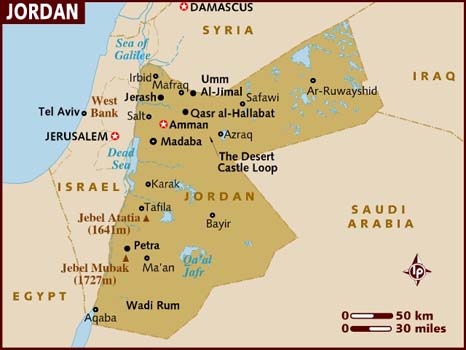
Cities/towns visited – Wadi Musa (Petra), Wadi Rum

Number of different lodgings – 2

Flights – 0

Bus journeys – 3

Boat rides – 0

Combi/collective/taxi  journeys – 5

Days of rain – 0

The Budget

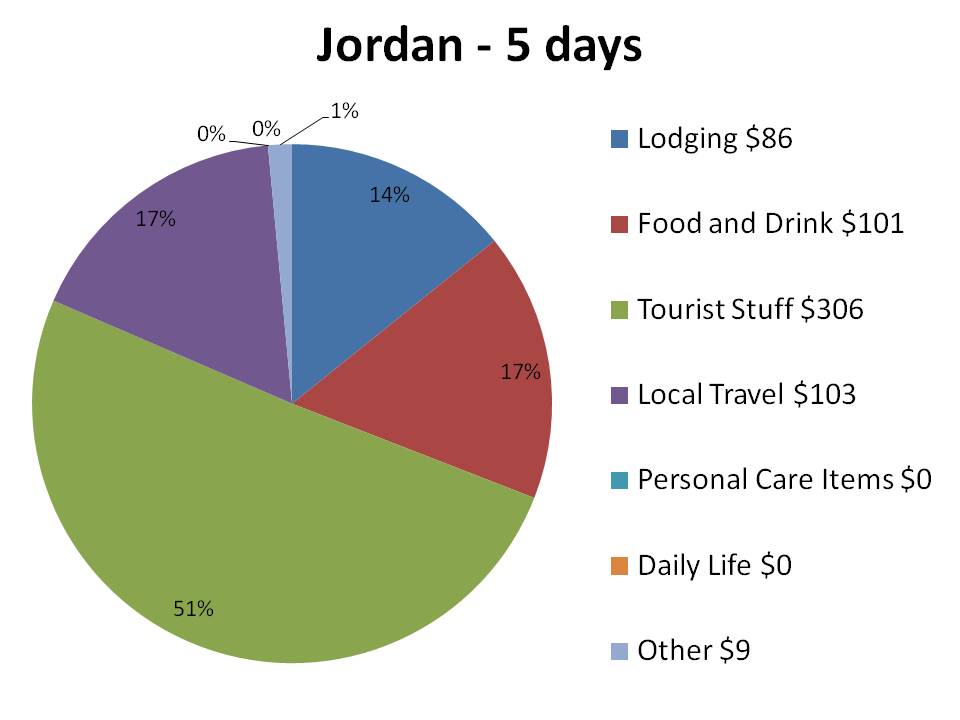
Total US dollar amount spent – $603.57

Average cost per day, per person -$60.36

Average lodging cost per night, per person – $14.29  We only stayed in one hotel (3 nights) and our 4th night was spent in the desert outside of Wadi Rum as part of a Bedouin overnight trip.  We had our own room/bathroom with just a fan in Wadi Musa (Petra), which was totally fine since the temperature drops significantly at night.  Breakfast was included.

Average food/drink cost per day, per person – $12.50.  Breakfast was included at the hotel, and they offered a great packed lunch service for about $5 which we took with us every day to Petra, and on the day we left since we had such a long bus ride to get to Amman for our flight. During our desert trip, dinner and breakfast were included.  We ate dinner out the other nights, at local budget restaurants.

The Best

Petra.  It’s just awesome.  This was the main reason we came to Jordan, and we were not disappointed by these ruins.  It’s got a hefty price tag, but it was worth it.  Do yourself a favor and spend at least 2 days exploring the site, but skip the ‘Petra by Night’.

The Treasury at Petra

The Worst

Wadi Rum and the Bedouin Meditation Camp.  We kept hearing about how great a trip to Wadi Rum was, and how we just had to go and spend a night in a Bedoiun camp.  I believe the words “magical” were used.  Yeah, well, we didn’t get it.  The deal is you take a fairly standard jeep tour of the area, then you kick back for the evening at a Bedouin style camp, have dinner, and sleep under the stars.  These trips don’t come cheap. The desert was nice enough, but not much different from some of the other desert landscapes we’ve seen.  Our guide was less than interactive, which was a huge bummer, and the camp itself was filthy with leftover food from the last trip rotting on the tables and counters, half-drunk water bottles strewn about in the sand, and used tissues littering the seating area.

The best part was sleeping out under the stars, which really is pretty awesome and on a clear night you can see basically the entire universe.  For the price, nearly $60 per person for less than 24 hours, we just didn’t think it was worth it.

To be perfectly honest, the other major problem we had, even in the very short 5 days, was the way I (Ashley) was treated by many of the men we encountered.  In the 110 degree heat, I wore long pants, and a long sleeve button up shirt the entire time.  Despite this, I was leered at nearly constantly, with the exception of when we were inside Petra.  In addition, many men did things like wink and lick their lips at me, or made mildly obscene comments as they passed me.  All of this was done right in front of Justin, who was angered, but didn’t really know what to do to stop it.  I want to point out that not EVERY man we crossed paths with behaved this way, but it was enough that I was ready to leave on day 3.

On the first day, we shared a taxi from the border of Israel, to Wadi Musa (a 3 hour drive into the desert where Petra is located) with two single girls, one of whom chose to sit in the front seat for the long ride since she is prone to motion-sickness.  At one point the driver reached over to her and began to stroke her hair and her neck, and we had to ask him to pull over so she could switch seats with Justin who was with me in the back.  She too was in a long skirt and long sleeved shirt.  It was wildly inappropriate, and I found it very bold that he would behave this way with all of us, including Justin, in the car.  We would have gotten a new taxi if we hadn’t been out in the middle of nowhere.

I was disappointed by these situations and felt a bit defeated, especially since we’d heard so many lovely things about Jordan.

Photo Friday – Baha’i Gardens in Haifa, Israel

10 Aug


* Right now we should be somewhere around Jagat on the Annapurna Circuit, in Nepal*


The Baha’i Gardens in Haifa, Israel surround the Shrine of the Bab, the resting place of the Prophet-Herald of the Baha’i faith.  There are 19 separate terraces of gardens, stretching from the foot of Mount Carmel to nearly the top.  There are only 3 sections that are open to the general public without a guide, and while they are lovely, they are very small.  We decided to take the hour-long free guided tour so we could walk through the entire length of the garden, and that proved to be a fantastic choice.  Our guide was very informative regarding the origins of the Baha’i faith, and we learned quite a lot about the foundations of the faith, and the basic beliefs of its followers.


Into The Great Wide Open

8 Aug

As you read this, we’re bumping along some dusty road in Nepal, on our way to start our trek of the Annapurna Circuit.  It’s monsoon here, and despite the fact that we’ve met a few people who’ve just completed the same route and had lovely weather, well, you never really know what’s going to happen.  As such, we aren’t sure how long we’ll be gone, but we suspect it’ll be somewhere between 13 and 18 days.  In the meantime, we’ve set some posts up so this space doesn’t get too lonely without us.

Keep checking in, and wish us luck as this is the longest trek we’ve ever done and the highest altitude we’ve ever been at!


The Israel Roundup

7 Aug

The Statistics

Number of days spent in country –  12

Cities/towns visited – Tel Aviv, Haifa, Akko, Jerusalem, Bethlehem (in the Palestinian Territories), Eilat

Number of different lodgings – 5

Flights – 0

Bus journeys – 6

Trains – 3

Boat rides – 0

Combi/collective/taxi  journeys – 2

Bike rentals – 1

Days of rain – 0

The Budget

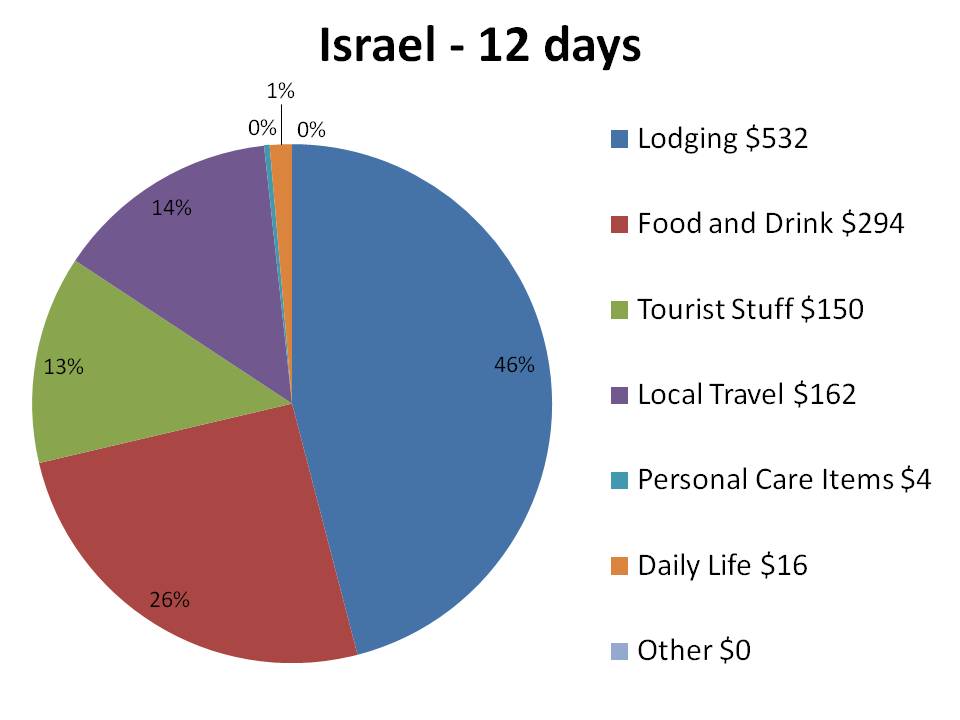
Total US dollar amount spent – $1,157

Average cost per day, per person -$48.22

Average lodging cost per night, per person – $22

Most expensive lodging – Our Airbnb stay in Tel Aviv was $33.50 per person, per night, but it was well worth it since two beds in a dorm room there would have been only slightly less.  Through Airbnb we were able to stay in our own air-conditioned room, in a fantastic area, in the apartment of a lovely couple who helped make our time in Tel Aviv so much better than it would have been on our own.

Least expensive lodging – $15.75 per person for a dorm bed at Corrine Hostel.  It’s got some crappy reviews on the hostel sites, but we didn’t think it was that bad.

Average food/drink cost per day, per person – $12.25  We had to really cut back on the food spending to compensate for the cost of lodging.  This doesn’t mean we ate less, it just means we didn’t go out to restaurants generally.  It’s super easy to grab cheap and filling shwarmas and falafel all over the place.  For dinners we mostly cooked for ourselves, which really means we ate hummus and pita by the kilo, and went to the market for fresh tomato, cucumber, cherries, apricots and olives.  It was fantastic.

The Best

Yad Vashem Holocaust Museum in Jerusalem – This is the world’s largest Holocaust museum and memorial.  We went on a Friday morning since it was one of the few tourist things open on Friday, and our biggest mistake was not giving ourselves enough time.  We spent nearly 3 hours here before we had to leave because the museum was closing, and we could have spent easily twice as long.   It’s the most organized and thorough museum we’ve ever been to.  There are dozens of short video narratives given by a number of survivors, and those were really the highlight for me.  Their stories are incredible and heartbreaking.  In addition, the museum has amassed a huge collection of person items salvaged from the camps, or thrown from the trains that took the victims to the death camps.  They do a very good job of bringing light to so many individual stories, as well as providing a thorough historical overview. Give yourself twice as much time as you think you’ll need, and bring a package of tissues.

In Akko you can visit ancient underground tunnels that were only recently re-discovered!

Akko – A smaller city north of Haifa that not as many tourists include in their plans.  Akko has a lovely old city that’s really worth visiting if you’re in the area.  We went for most of a day as a side trip from Haifa and had plenty of time to see most of the old city.  We also had some fantastic falafel from a street vendor there.

Green Bikes in Tel Aviv – Tel Aviv has recently implemented a new bike rental system similar to what London has done.  There are bike stands set up all over the city and you can pick them up and drop them off at your leisure.  You can rent by the day, week, or month, and it’s very affordable, even on a tight budget.  For less than $5 each we were able to pedal all over the city!

Taking a dip in the Dead Sea – Incredible!  We had read all the stories about how you simply can’t sink, but to experience it for ourselves was so much better than we anticipated.  You really can’t sink!  We had a blast covering ourselves in the mud and watching crazy lines of salt dry on our skin.

The Worst

Eilat.  We had heard that Eilat was fantastic from a number of people, but honestly, we weren’t impressed.  We snorkeled one day, which was nice, but other than that, we found it kind of ‘meh’.  It’s a good stopping point if you are travelling between Israel and either Jordan or Egypt, but we didn’t need more than a day there as there’s not a whole lot going on and the beaches aren’t anything to get excited about.

Photo Friday – The Monastery at Petra, in Jordan

3 Aug

The Monastery is truly massive. See that blob below the main doorway? That’s a person!

There is no doubt that the main attraction at Petra, just outside of Wadi Musa in Jordan, is the incredible stone Treasury building.  However, we’d like to argue that the massive monastery is just as impressive, and if you come during shoulder season as we did, you might have it nearly all to yourselves.  Both buildings have been carved right into the sides of the mountains that surround the area, and both will absolutely take your breath away.  The Monastery is high on a hill at the end of the tourist section of Petra, and getting there will require that you haul yourself up somewhere around 850 stone stairs.  We made it without too much of a struggle in the oppressive mid-day heat of late June, though we imagine it’s probably much more pleasant in the early morning, or during the winter.

As an alternative, you can hire a horse or a donkey to cart you most of the way up.  If you must go this route, I’d advise you to chose your vendor carefully since we saw more than one animal being openly mistreated, and we even witnessed one man punching an uncooperative horse in the face.