Tag Archives: photography

Road Trip – Bolivian Salt Flats

21 Aug

*If the weather held up, we should be done with our trek and chilling out in Jomsom.  We might even be on our way back to Kathmandu!*

The salt flats in Bolivia seem to go on forever!

For a country that is quite small in comparison to some of its neighbors, Bolivia has a lot to offer in terms of travel possibilities.  There are mountains, volcanoes, jungles, lakes and deserts, and it’s relatively easy to move from one place to another.  We were intrigued by the possibilities and one of the major ‘must see’ items on our list was the famous salt flat near Uyuni.  There are a myriad of ways to visit this area, but since we were making our way up from Argentina, we chose to do a 4 day jeep tour that began in Tupiza, and ended in Uyuni.

We’d already been travelling with our friends Kristin and Bryan from Happy To Be Homeless and were planning on meeting up with another friend, Eric from Ric and Roll, in Tupiza.  It’s easy enough to cruise into town, especially with a ready-made group of 4-5 people, and book a trip leaving within a day or two. We set out early in the morning, our packs strapped to the top of our Landcruiser, ready to see some of Bolivia’s highest lakes and desert formations.

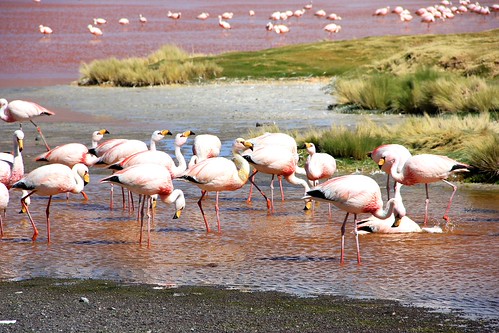
Over the next few days we drove hundreds of kilometers on roads that often weren’t really roads at all, sometimes on ledges that were terrifying, or through dry riverbeds dotted with massive rocks. We spotted small villages, huge lakes, towering volcanoes and tons of flamingos.  That’s right, flamingos.  As it turns out, something about the altitude and composition of the mineral lakes (some of which are poisonous to humans) makes a perfect habitat for flamingos, of which there are thousands.  It was fascinating to see the bright bursts of pink these birds  provided in the otherwise stark landscapes.
One stop had us soaking in a hot spring, which was especially nice after being quite cold for most of the trip.

One of the most surprising sights was the huge amount of quinoa that dotted the landscape.  It’s a colorful crop and farming it is one of the major sources of income for locals in this area.The other common income source is raising llamas, which were also quite abundant.  Many of the animals have “pierced” ears, with different color poms that serve to identify them as they wander around the plains.

At our highest point, over 5,000 meters, there were amazing sulfurous hot mud pits that boiled and gurgled like a horrible stew.  It was both terribly smelly and oddly fascinating.

As we neared the end of the trip we wandered among huge rock formations that seemed to come out of nowhere.

When we finally arrived in Uyuni we took some time to visit the train cemetery before tucking in for the night since we had to wake up before dawn to make it to the salt flats before sunrise.  This was much more interesting than we anticipated, with all kinds of old trains abandoned and sunk into the ground.  Some clever folks even created playground equipment, including see-saws and a swing, from old train parts.

The salt flats were just as incredible as we had imagined, and we couldn’t have asked for a better sunrise.

After driving far out onto the flats to have space all to ourselves, we spent hours, literally, taking fun optical illusion photos with the expansive white background.

For more photos, check out the slideshow below.  Click to expand it to full-screen in flickr, or to see the individual photos.

Word On The Street

—————————————————————————–

There are loads of different ways to organize a trip to Southwest Bolivia and the salt flats.  It’s a huge tourist draw, so there are literally dozens of companies clamoring for your dollars, which is all the more reason to be really clear about what you expect from a trip.  You can do the four-day trip that we did from Tupiza, but you can also go from Uyuni and do it in the opposite direction.  We used La Torre Tours and were really happy with them.  Tupiza Tours is another company we looked at that gets good reviews from travelers.

With our group of 5 we paid about $150 per person for the whole trip, excluding the park entry fees and tips for the driver and cook.  Our driver was excellent, and though he spoke no English, he made a serious effort to communicate with basic Spanish and to speak slowly for us.  We were able to understand him most of the time and if you have a basic level of Spanish you should be fine.  If not, you can pay more for an English-speaking guide.  Our cook was very sweet, and the meals were basic, but plentiful.

If you arrive on your own, you can either meet up with other travelers and form a group, or shop around and get a space in a partially filled jeep.  Tours leaving from Tupiza usually have 4 people per jeep, while those leaving from Uyuni tend to cram 6 people in.

If you can’t, or aren’t interested in a 4-day tour, you can go for shorter routes from either Tupiza or Uyuni.  If you are really short on time, just head into Uyuni and sign up for a one day tour of the salt flats, it should be cheap, and totally worth it.

Photo Friday – Dome of the Rock, Jerusalem

17 Aug

*Right now we should be getting ready to cross the Thorung La Pass on the Annapurna Circuit in Nepal.  Cross your fingers for us, this sucker is nearly 18,000 feet!*

The Dome of the Rock, in Jerusalem, is particularly gorgeous because of its vibrant tile-work in the midst of the white stone buildings that surround it.   We’re always blown away by the tile and mosaic work that is common in Islamic architecture, and this is one of the few buildings that is decorated on the outside just as intricately as most others are on the inside.

Photo Friday – Baha’i Gardens in Haifa, Israel

10 Aug


* Right now we should be somewhere around Jagat on the Annapurna Circuit, in Nepal*


The Baha’i Gardens in Haifa, Israel surround the Shrine of the Bab, the resting place of the Prophet-Herald of the Baha’i faith.  There are 19 separate terraces of gardens, stretching from the foot of Mount Carmel to nearly the top.  There are only 3 sections that are open to the general public without a guide, and while they are lovely, they are very small.  We decided to take the hour-long free guided tour so we could walk through the entire length of the garden, and that proved to be a fantastic choice.  Our guide was very informative regarding the origins of the Baha’i faith, and we learned quite a lot about the foundations of the faith, and the basic beliefs of its followers.


Photo Friday – The Monastery at Petra, in Jordan

3 Aug

The Monastery is truly massive. See that blob below the main doorway? That’s a person!

There is no doubt that the main attraction at Petra, just outside of Wadi Musa in Jordan, is the incredible stone Treasury building.  However, we’d like to argue that the massive monastery is just as impressive, and if you come during shoulder season as we did, you might have it nearly all to yourselves.  Both buildings have been carved right into the sides of the mountains that surround the area, and both will absolutely take your breath away.  The Monastery is high on a hill at the end of the tourist section of Petra, and getting there will require that you haul yourself up somewhere around 850 stone stairs.  We made it without too much of a struggle in the oppressive mid-day heat of late June, though we imagine it’s probably much more pleasant in the early morning, or during the winter.

As an alternative, you can hire a horse or a donkey to cart you most of the way up.  If you must go this route, I’d advise you to chose your vendor carefully since we saw more than one animal being openly mistreated, and we even witnessed one man punching an uncooperative horse in the face.

Photo Friday – Feeling Blue In Jodhpur, India

27 Jul

We’ve spent the last few days wandering around Jodhpur, India, which is often referred to as the “Blue City” because so many of the buildings in the area around the old fort have been painted blue.  The most common reason people give as to why this particular color was chosen is that it keeps the bugs away.  Whatever the reason, it’s very cool to walk around in a blue neighborhood, and even better to get an expansive view like the one from the top of the fort.

Photo Friday – Ajanta Caves in India

20 Jul

The Ajanta Caves, a UNESCO World Heritage Site, are located about 100 kilometers outside of Aurrangabad, India (it takes about 7 hours on a train to get to Aurrangabad from Mumbai) and while the oldest of the caves date back to the 2nd century BCE, they weren’t widely known until 1819 when a British tiger hunting party stumbled across them.  The caves are a series of 30 rock-cut caves that depict Buddhist religious art.   They range from small and very simple to multi-storied ornate spaces.  They’ve been fairly well-preserved, with some of the interior cave paintings still in decent condition.

Photo Friday – Delicious India

13 Jul

We’ve only been in India for a week, but already it feels like we’ve had a million food adventures!  Coming from New York, you’d think we would have more experience with this cuisine, but the truth is we really know almost nothing about Indian food.  As such, we’ve been ordering at random every time we need to eat, and we haven’t been disappointed yet!  This week’s photo is thali, which is like a sampler with all kinds of different flavors.  They have been our favorite because you get to taste a bunch of different things and they usually include something sweet like the honey soaked ball of bread or dough or something you see in this one.  Delicious!

Photo Friday – Tribal Face Paint in Ecuador

6 Jul

During our Ecuador jungle trek we had part of a morning to visit the local shaman.  While we were waiting for him to arrive, our guide took the opportunity to have a little fun with a local plant that has been traditionally for face painting.  When ripe, the seeds inside of the flower pod are an amazingly bright red.  Some local tribes use the coloring as face paint, others use it to color their hair.  Justin was a good sport and agreed to have his face painted, and luckily he had no trouble washing it off at the end of the day.

Photo Friday – Oh (not so) Little Town of Bethlehem

29 Jun

While we were in Jerusalem, we thought we’d take a little dip into the Palestinian Territories to visit Bethlehem and the Church of the Nativity.  We took a local bus, which dropped us off just outside the center of what is now quite a bustling little city.  As we made our way through the markets and down to Manger Square, we came across this lovely little road.  Contrary to what the news might have you believe, there are at least parts of the Palestinian Territories that are perfectly lovely, and this is one of them.  The town’s building are made almost exclusively with the same beautiful white rock as in Jerusalem.  The streets are clean, and the people were very kind.  We had no trouble finding our way to the church and even stopped to have a beer at a little cafe on the way back to the bus.  The day definitely helped to remind us that while things make the news for a reason, a place can’t be defined only by what you see on the television.

Photo Friday – Spice Market in Jerusalem

22 Jun

The spice stall

Local markets are probably my favorite place to spend time in a new city.  You can learn an incredible amount about local culture by wandering around the market and seeing what’s for sale, which usually includes everything from local produce to local fashion.  Jerusalem’s old city has an extensive market.   Parts of it are geared nearly completely to tourism and you’ll find stall after stall of t-shirts, rugs and trinkets, BUT, if you wander off a bit down the side streets you’ll encounter the local market stalls.  We passed this vendor selling spices, clearly still close to the tourist center as the labels are in English, and the smells were intoxicating.  I want to bottle it up and be able to take it with me…perhaps a new flavor of scratch-and-sniff is in order?