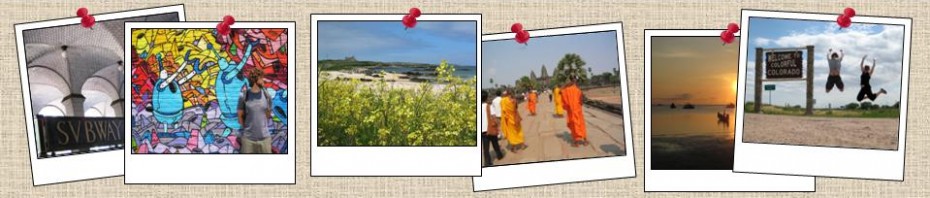
Ankgor Wat is undoubtedly the biggest tourist draw for the temples outside of Siem Reap in Cambodia, but there is so much more if you have a day or five to explore. There are dozens of smaller temples in the surrounding area and most of them boast intricate carvings, some of which are very well preserved. These particular figures can be found along the walls near the Elephant Gate, and we were fascinated by the different colors each figure had taken on despite the fact that they are all basically exposed to the same natural elements. Some were simply grey as the stone they’d been carved from, others were shades of green and red. Each figure is unique, and we spent nearly an hour wandering along the wall and inspecting the the details.
The India Roundup
9 OctThe Statistics
Number of days spent in country – 33
Cities/towns visited – Mumbai, Aurangabad, Madgoan, Hampi, Mysore, Bangalore, New Delhi, Jodhpur, Pushkar, Jaipur, Agra
Number of different lodgings – 13
Flights – 1
Bus journeys – 20
Train trips – 10
Boat rides – 6
Taxi journeys – 2
Rickshaw rides – 23
The Budget
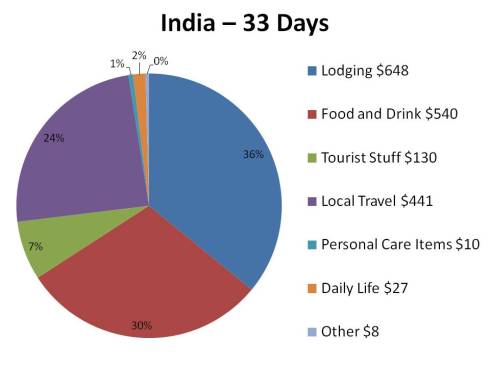
Total US dollar amount spent – $1955 (includes cost of visas – $76 each)
Average cost per day, per person -$29.62
Average lodging cost per night, per person – $10.80 – We generally stayed in hotels with a private bathroom and air conditioning. You can go much lower than this if you are on a budget, but we found that we couldn’t tolerate the lack of basic sanitation at lower price ranges. On three occasions we splurged on much nicer rooms than we would normally take, mostly to have access to a nice pool.
Most expensive lodging, per person – $19.25 at the Welcome Hotel in Mumbai – double room with air conditioning, breakfast included, shared bath. Not the best value, by far.
Least expensive lodging, per person – $1.80 at the White Elephant in Hampi for a double bed bungalow with fan and private bathroom.
Average food/drink cost per day, per person – $8.18 We ate out for 3 full meals per day, mostly in local, but mid-range restaurants. It was monsoon season and we were advised to stay away from most of the street food during this time. We ate like royalty in this price range and you could definitely do it for less if you stuck with super cheap street food. We had almost no alcohol in India, but if we had it would certainly have doubled our spending.
The Best
Hotel – Devi Bawhan in Jodhpur. We stayed here for the weekend of our anniversary and while we intended to stay just one night because of the cost ($38 per night, which is a steal by Western standards and slightly cheaper than one of our hotels in Mumbai), it was so lovely that we ended up extending our stay to three days. The hotel gardens were lovely, the rooms were very well appointed, large and clean with air conditioning that worked very well. The pool was clean and chlorinated (not always the case with hotel pools). The staff spoke excellent English and were kind and helpful. It’s a little far out from the center so you must take a rickshaw to the tourist sites, but that made it a very peaceful stay.
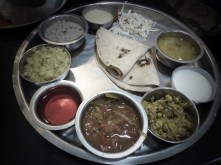
All the food. Seriously. We just walked into restaurants that seemed busy and that had a price range we were comfortable with. We ordered at random from the menu most of the time and generally the food was plentiful and delicious.
The Only Place in Bangalore – If you are craving some good ol’ American grub, this is the place to be. They have burgers, lasagna, mac and cheese, and good apple pie. The prices are tourist range, but the portions are big and the flavors will make you feel right at home.
The Mango Tree in Hampi – The view over the river in Hampi makes this spot stand out in our memories. The food was consistently good, we ate here every day that we were in Hampi. It’s a 5 minute walk outside of the main village area, but it’s not far, and it’s totally worth it.
Monsoon Mangos – Travelling during the monsoon season can be a pain. Rain POURS in some places, and it’s hot as hell in other places. One serious benefit of the monsoon is the abundance of delicious mangos that ripen in this period. We gorged ourselves in Mumbai and Goa on fresh, juicy mangos that can be bought cheaply all over the place.
Mysore Palace – We’ve seen a lot of tourist sites, but this one is truly awesome. The price is 300 times higher for tourists than for locals (the norm across India) and this is one time where it was completely worth it. The palace is in excellent condition (no photography allowed inside, so you’ll have to take my word for it) and truly made us want to go back in time and live like Indian royalty.
Hampi – Filled with ancient temples and surrounded by a crazy landscape full of giant boulders, this turned out to be one of our favorite places in India. The town is very mellow, the pace is super slow, but there is enough to do to keep you occupied for at least 3-5 days. When you are all templed-out, you can rent a scooter and go zipping around the countryside to visit lakes and crazy rock formations.
Train travel – If you go to India and don’t travel by train then you are out of your mind. We took trains all over the place, everything from short 2 hour trips to long-haul 27 hour journeys. For the overnighters we stayed in AC 3rd class, which was just fine, and on shorter trips we just went with the general non-ac standard sitting class, which was usually fine. The trains were where we met the nicest people we encountered on our trip. Whole families would strike up conversations, share their meals, and give us advice about where to go and what to see. In addition, you get to see some gorgeous, and some not-so gorgeous, landscapes along the way. You can book online using cleartrip.com (also a great resource just for checking schedules etc) but we mostly booked at the train stations using the foreign tourist counters. In high season seats can book out as far as 3 months in advance, so be prepared to plan ahead.
The Worst
Hotel Empire International in Bengaluru – A decent location, and better priced than most things in the area, but overall a big pile of suck. The hotel itself is generally run-down, and they lied to us about the type of room we were in – they were charging us for a ‘deluxe’ fan room even though we were placed in a standard fan room. We questioned the charges because the room didn’t seem to match their own description of ‘deluxe’ but we only knew for certain that we had been over-charged when we insisted on a room change after discovering ours had a roach infestation. They tried to tell us they only had AC rooms left, but when we threatened to leave without paying they reluctantly changed our room to…surprise, surprise, a real ‘deluxe’ fan room. We hadn’t been so blatantly deceived by a hotel until this point, and it left a very nasty impression.
Photo Friday – Offerings in Bali
5 OctWe were fortunate to be touring temples in Ubud, Bali during a holiday based around the full moon (though the celebration only happens either twice per year, or once every seven months…we keep getting conflicting information). The temples were packed with locals, the women dressed in brightly colored silks while the men wore crisp white shirts and patterned sarongs. We hung around on the sidelines and watched dozens of women parade by, carrying the offerings – gigantic platters of fruits, roasted duck, and sweets – on their heads.
It’s The Little Things – Essential Items for Long-Term Travel
2 OctEarlier today, as we were trying to avoid walking through a thick stretch of tourist market in Ubud, Bali, we were talking about how light we feel without the need to have all the ‘stuff’ that we regarded as essential for our daily lives when we were in NYC. Our priorities have obviously shifted, and as such, our essential items have also shifted.
When we began to gather our gear for this trip we spent a lot of time thinking about what would suit our needs best. Our packs can only hold so many things, so we wanted to make sure that we weren’t filling the space with frivolous items. We searched other long-term travelers’ packing lists and made lists of our own. We bought, and returned what seemed like a million different items of quick-dry clothing. We were even running around on the last day before we left trying to gather those last minute items that we had forgotten about.
A few months ago we finished posting our own packing lists in the hopes that others might find them useful. Today we’d like to narrow those items down into a list of little things that, as long-term travelers, we have found to be the most useful over the course of the last year.
Cheap flip-flops – This might seem obvious, but if you plan on staying in dorms these are essential for avoiding foot plague and other nastiness in the common showers.
Packing cubes – I never really understood these, but now that we pack up and move every few days I see that they are a huge lifesaver. Nearly everything in our packs goes into a cube, and then the cubes go into our bags in a jigsaw-like manner to maximize space. It makes it so that we can each get packed, empty to full, in just a few minutes.
Small combination lock– Again, this might seem obvious to some, but we’ve used our locks for everything from hostel lockers, to just locking our bags every day when we leave our rooms (we lock the laptops, etc inside them). Sure, people could slice the bag open to get to our stuff, but it prevents opportunistic theft. We also carry a little package of zip ties that we’ve used to secure smaller bags when we’ve had to leave items with a hostel (like when we go on multi-day treks).
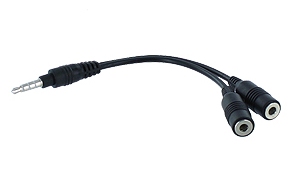
Headphone splitter – Sometimes we want to just have a night in to be ‘normal’ and watch a movie. These allow us to watch movies together on one laptop.
Quickdry towel – This is not my favorite item (it’s like drying yourself with a chamois), but has been one of the most useful. We’ve stayed in many places, mostly in S. America, that didn’t provide towels, so these were essential. In addition, when we hand-wash clothes we find that they dry more quickly when you wring them out in a towel, and these towels not only absorb tons of water, but they dry in only a few hours.
Smartphone – We brought Justin’s phone with us, even though we cancelled his plan (and it doesn’t use a SIM card so we can’t use it for calls), because we use it for an alarm clock, emergency wi-fi, and GPS. If we connect to wi-fi we can download maps of our destinations, which is incredibly helpful when you arrive in a new city and aren’t exactly sure where to go. It was also essential in India where they don’t always announce train stops…without this we definitely would have missed some of our stops!
Multi plug thing – This is one of those plugs that allows you can charge 3-4 things at once. With two laptops, two I-pods, two kindles and two cameras this allows us to make sure we’re always charged up and ready to go, even if we get a room with only one outlet. It’s important to just get a two-pronged plug unless your voltage adapter allows for grounded plugs. No need to go fancy with this, we picked ours up at a hardware store for less than a dollar.
Sleep sheet – We never would have expected it, but this has turned out to be one our most useful, non-clothing item on this trip. They are made to be used when a place lacks sheets, has questionable cleanliness, or to put inside a rental sleeping bag. We’ve used them for all these purposes, but also for loads more, including – warmth on long, cold, bus rides; as sarongs when we need to enter temples in Bali; as beach towels (they are huge, so your whole body fits on them!); and as a laundry bag.
As a counter to our favorite items, we figured we should include some of the crap we didn’t need after all:
Money belts – Justin doesn’t carry a wallet, so that solves his pick-pocket problem. We do have an Eagle Creek money belt that we really like, and he used to wear it on the long bus rides in S. America, but honestly, we haven’t used it in at least 5 months. We keep it around just in case. I had a more traditional money belt, and again, I used it once or twice on overnight bus rides, but other than that it just sat in my pack and wasted a little bit of space. I got rid of this after 6 months.
Pacsafe – We got it ‘just in case’. We NEVER used it. We sent it home after 6 months..
Ethernet cord – In some places this might be a good idea, but we’ve found that most places have wi-fi, and if they don’t, they don’t often have wired internet either. Not a huge waste of space, but totally unnecessary.
Tell us, what are your ‘must-have’ travel items?
Photo Friday – Prayer Wheels in Nepal
28 SepOne of our favorite parts of hiking in Nepal was coming across one of the many prayer wheel walls. Some were ornate and meticulously cared for, while others were made of old coffee cans with the prayers hand painted on them. We always took care to walk down the correct side, and spin each wheel as we passed by.
Photo Friday – Sunsets in Koh Tao, Thailand
21 SepWe’ve spent the last week lounging about and stuffing our faces on Koh Tao, in Thailand. My brother has been living on this little island for nearly 10 years, and even though we’ve been to visit him before, we never get tired of watching the sun set from one of the many local beach bars. After three days of clouds and rain we finally got a hot sunny day and were happy to sit at my brother’s bar, Maya Beach Club, sipping mojitos and checking out the longtail boats as they bobbed around on the tide.
Photo Friday – Angkor Wat, Cambodia
14 SepI first went to Angkor Wat in 2005, and while there were plenty of visitors, it was nothing like our experience there last week. Tourism is booming in Cambodia and has definitely brought some changes. One of them is the inability for people to go climbing about on the temples as they please. In 2005 I snapped this shot of a monk climbing up the central tower in Angkor Wat. There was almost nobody else around and he had stopped to catch his breath, or perhaps just to admire the view and I happened to look up and catch him gazing out at the front of the temple complex. Today, you can’t just make your way up the crumbling stone steps, they have built wooden platform stairs on top of the originals, you have to wait in a long line to go up, and you are restricted to a brief 20 minute visit. It was sort of a bummer to not be able to wander at our leisure, though the new rules do make it safer, and better for the preservation of the temples.
Photo Friday – The Annapurna Circuit, Nepal
7 SepHiking up to the Thorong-La Pass on the Annapurna Circuit in Nepal was one of the most difficult days of our 12 day trek. We were both feeling a bit loopy from the altitude, and I had been battling a little headache since the night before, which was creating a bunch of stress about whether I was going to suffer the consequences of altitude sickness before I managed to make it to the top of the pass. We were so immersed in our own thoughts that it took a while for us to notice that the thick fog that we’d been hiking through for the last hour was no longer surrounding us. We turned around and realized that we’d broken through the clouds and could finally see some of the peaks behind us. We had just a few minutes of this view before the clouds rose up and obscured the views again. It was a good reminder to stop every once in a while and take a look at the majesty that surrounded us.
The Nepal Curveball
5 SepWe went to Nepal to get away from the cities and the pollution and the general chaos of constant travel. We knew that hiking the Annapurna Circuit would be both challenging and rewarding, and our entire trip to this lovely country revolved around the hike. That is, until I got sick.
We had just finished our 150 kilometer trek and we were incredibly sore, but feeling really good about successfully carrying our own gear and still making it all the way through on our original schedule. I went to bed that night dreaming of relaxing back in Kathmandu with a giant burger and a beer.
The next morning I woke up feeling, off. It was cloudy and we suspected our flight out of Jomsom would be cancelled, but we dragged ourselves out of bed at 6am and headed to the airport anyways. By 8am it was crystal clear that not only was the flight not going to happen, but also that I was getting sick. I spent the next 20 hours attempting to fight off a fever and shivering uncontrollably despite being buried in both of our sleeping bags AND two huge blankets. I figured this was my body’s way of getting back at me for all the long and punishing days of hiking.
The next morning I still felt unwell, but our flight was set to go so I rallied myself and managed to survive both the flight as well as the very long and bumpy bus ride back to Kathmandu. I figured once I had a good shower and some clean clothes I would be feeling much better.
I was wrong.

Justin kindly took a photo of me feeling quite ill. In retrospect, I don’t look nearly as bad as I felt at this point.
I woke up in the middle of the night, feverish again, and started to worry that something was really wrong. By the next afternoon I still had the fever and it seemed to be getting worse. We started to think I might have gotten malaria, despite taking anti-malarial meds all through India. Justin called the US Embassy to get a recommendation for a doctor and we were directed to the CIWEC clinic, which caters mostly to foreigners and expats.
A few hours and many vials full of blood later I was informed that I would not be going back to the hotel that day. The good news is that I didn’t have Malaria. The not so good news is that they thought I had Typhoid Fever, though they sent out some blood cultures just to be sure.
Typhoid Fever is typically transmitted to travelers by an infected person who does not wash up properly after using the toilet, and then prepares food. I had gotten the vaccine but the doctor said that while it’s ok to have, it’s really not much more protection than having an umbrella with a huge hole in it during a thunderstorm.
I was started on a series of both oral and IV antibiotics and told that the fever would likely not be getting any better until the infection was cleared. They were right. I had a raging fever, reaching 102.5 – 103 degrees most days, for a total of 10 days. The fever was accompanied by stomach pain, a complete inability to eat more than a few bites of toast at a time, and some of the worst headaches I’ve ever had.

During one of my better moments I manage to use the hospital’s wi-fi to break up the monotony of the day.
After a few days the blood tests came back, but they were all negative. After that I had to give blood samples every few days so that they could test for other types of bacteria and viruses, and in the meantime they added two more antibiotics to the mix just to cover all the bacterial bases.
Finally, after what seemed like an eternity in the hospital, though it was really just about a week, the fever broke and stayed away for 24 hours. Armed with baggies full of the rest of the antibiotics, I was released from the clinic, even though there was never a definitive diagnosis as to what I had. The medical records I was given when we left the hospital state that it was a case of “possible Typhoid” since the blood tests apparently often come back negative when up to 50% of the time they should be positive. It’s been 5 days, I’ve finished the antibiotics, and am finally feeling more like myself again.
After all our time preparing for the Annapurna trek, it’s frustrating that we didn’t have any time to revel in the accomplishment immediately after completing the journey. The illness came on so fast, and so strong, that it seems like that’s the only thing that happened in Nepal. We’ve finally managed to pull the hundreds of photos of the hike off our memory cards and now we need to sit down and make a point to go through them and focus on those 12 days of struggle and success so that the better memories can rise up to the surface and overtake the blur that the fever created.
In the meantime, we are hanging out in Thailand, re-acquainting ourselves with our old friend ‘beer’, and making plans to go visit my brother, who lives a life full of awesome on a little island in the Gulf of Thailand.
Photo Friday – The Taj Mahal, India
31 Aug
The Taj Mahal is one of the worlds most well-known pieces of architecture, and seeing it in person is just as impressive as you think it will be. We certainly took our fair share of the standard straight-on photo from the beginning of the gardens, but we also liked the views you get as you peek out massive doorways of the mosques that sit on either side of the Taj Mahal.