Big Ice – Trekking the Perito Moreno Glacier in El Calafate, Argentina

20 Mar

Perito Moreno Glacier in El Calafate, Argentina

Wow, that title sure is a mouthful.  The thing is, any post about the Perito Moreno Glacier in El Calafate, Argentina deserves such a title because the glacier itself is so huge.

Perito Moreno has been on our South American Must-See list for as long as I can remember.  While it’s not the biggest glacier in the world, it is one of the most accessible and tourists come in droves from all over the world to get up close and personal with this giant hunk of ice.  It measures 97 square miles, and is part of the Southern Patagonian Ice Field on the border of Chile and Argentina.  This ice field is so massive that it contains nearly 1/3 of the world’s fresh water.  It stands at a height of about 250 feet, and that’s just above the lake! One of the most remarkable things about Perito Moreno is that it’s one of the only glaciers on Earth that continues to grow instead of melting away into oblivion.

Close up of the ice formations on the Perito Moreno glacier

There are a million varieties of tours you can take when you visit – everything from boat rides that get you up close to the face of the glacier, to bus/boat combos, to ice trekking tours.  You can also go on your own and take a public bus to the park entrance and spend the day wandering the catwalks.  Despite the fact that we have generally been living like paupers, we decided to go ahead with a major splurge for our chance to spend a day doing some ice trekking.  There’s only one company in town that runs this show (heeellloooooo monopoly!) so we forked over way more cash than we should have, and attempted to go to bed early since we were getting picked up bright and early the next morning.

We were a bit bummed to be greeted with a drizzly morning, but we layered up, grabbed some extra plastic bags for the camera gear, and hopped on the Hielo & Aventura bus at 7:30am.  It takes about an hour to reach the glacier from town, and as our bus rounded the bend to give us our first glimpse of the ice, the driver slowed way down and blasted comically dramatic music to heighten the atmosphere.  We were given an hour to walk around the catwalks and take photos before we boarded a boat for a ride across the front of the glacial lake to where we would get our gear for the ice hike.   After a moderate climb up behind the edge of the glacier we were given gloves and crampons and split into very small groups to begin the trek.

Be careful when walking!

Hiking on ice is fairly straightforward.  Make sure your crampons are on tightly, then lift your feet and smash them down into the ice to make sure you have a good grip.  Keep your feet enough apart that you don’t rip your pants or skewer your own calf, which apparently has happened more than once on these tours.

Our guides were fantastic and took us on a long and meandering path where despite the fact that we knew the other groups must be close, we didn’t see them at all.  The ice is constantly moving, changing shape, melting and re-freezing.  This makes each trip unique, and some features that we saw will have totally vanished in the time it took me to actually get this post up (6 weeks since we visited).

We saw numerous ice caves, including one that was big enough for us to walk inside, though we had to really watch our step because it was split down the middle with a crevice that was easily 20 feet deep.  The inside was perfectly smooth, slippery and so blue that we almost glowed.

Inside the ice cave

An erratic rock on the Perito Moreno glacier

We also saw numerous ‘erratic rocks’, which are rocks that tumble down the mountains that surround glaciers and are then carried by the movement of the glacier.  Eventually, when the glacier is gone, the rocks will remain and appear completely out of place since they are often carried great distances and then deposited in the valleys and flatlands created by the glacier.

It’s a very surreal feeling to be out in what seems like the middle of nowhere on something that is as foreign as the surface of the moon.  The ice changes texture and shape often so there is always something new to look at after walking just a short distance.  The surface is deceptively peaceful since one wrong step can leave you crashing through a thin spot, or slipping into one of the fast moving rivers that form on the surface as parts of the ice begin to melt.  Above all, it’s exquisitely beautiful.

Ice landscape

Top of Perito Moreno glacier

Lunar ice landscape

After tromping around for nearly 5 hours we were completely exhausted and were taken back to the boat landing to begin the journey home.  Much to our surprise and delight, we were given a chocolate biscuit and a healthy glass of Jameson on glacier ice (yes, for real) to finish off the day.

This was easily the most expensive tourist day trip we’ve done so far on our journey, and it was totally worth it.

————————————————————————————————-

Word On The Street
* The Perito Moreno glacier is part of the Los Glaciers National Park in Argentina, about an hour outside of El Calafate.  You can visit parts of the park for free (notably, in El Chalten, Argentina) but you must pay an entrance fee to see the Perito Moreno glacier.  At the time of writing, the fee for international tourists was $100 pesos.
 
* There is only once company that can take you out onto the ice – Hielo and Aventura.  They offer a Mini-trekking tour, which is a half-day trip, or the Big Ice trip, which ended up being a full 12 hours, door to door.  We highly, highly recommend the Big Ice trip if you are fit as it seemed like a much better value.  The Big Ice tour costs around US $175 and the Mini-trek is less, somewhere around US $140.  Prices can be higher if you book ahead with a travel agent, but most hostels will book at the same cost as going directly through the company.
 
* Waterproof shoes are essential.  Waterproof jacket and gloves are a good idea, especially if the weather isn’t being cooperative, though Hielo and Aventura will loan basic gloves if needed.  Crampons are provided.
 
* You’ll need to bring your own lunch, and you’ll eat it on the ice.  Having a bag to sit on is a good idea. 

————————————————————————————————-

For more pictures, take a look at the slideshow below!

Packing List Part 4 – Miscellaneous Gear

12 Mar

It’s time for another installment of the packing list series!  If you haven’t checked them out already, head over to our “Things We Carry” page and check out our first three lists – ‘Clothing, ‘Medical and Toiletries’ and ‘Electronic Gear’.

We’ve tried to be as prepared as possible for situations that we know we’ll encounter, but we also wanted to make sure that we were bringing things that were durable and that we’d use regularly.  For the most part we did really well in that regard, especially when it comes to the miscellaneous gear that we cart around.  There are a few exceptions though, the biggest being the pacsafe cable.  This was on a lot of ‘must-have’ lists we looked at, so we got one…and we’ve never used it.  Most of the hostels we’ve stayed in have had lockers, and when they haven’t, we just lock everything up in our packs using our regular luggage locks.  I’ve never felt the need to lock a pack to something, though I suppose that could happen somewhere down the line.

The other thing we haven’t really used much have been the backpack rain covers.  We’ve seen people who keep them on practically all the time, but we just haven’t found them necessary at this point.

Click on over and check out  the full list of our miscellaneous gear.

Moving Box Bet – Argentina AND Uruguay!

7 Mar

If you are unfamiliar with our Moving Box Bet series, check out Justin’s first challenge from Peru, and his second challenge from Chile.

It took a long time for us to find a suitable food challenge for Justin in Argentina.  This mostly has to do with the fact that just about everything we’ve come across here is delicious!  Argentina has a lovely mix of Spanish and Italian heritage, and as a result you get some great pasta, pastries, and meat.  All of these we love, so you can see the dilemma.

In Argentina, people eat a lot of meat.  A lot.  Parillas (place that cook meat on a grill) are a dime-a-dozen, it’s an Atkins diet dream come true.

One thing we discovered in our quest to get better at reading menus is that people here eat every part of the cow.  Seriously.  Every part.

This diagram is missing a few key elements...

It is not uncommon to find sweetbreads or other organ meats on the menu.  Lonely Planet even lists ‘ubre’ (udder) in the food glossary, which mean you must be able to find that in at least a few establishments.  We had resigned ourselves to the fact that we would simply have to find a place that could grill up some good thymus gland and that would suffice for Justin’s challenge, despite the fact that it’s really not all that unusual.

That was before we met our couchsurf host.

We had the pleasure of staying with a fantastic family for most of our time in Buenos Aires, and we shared the concept of the Moving Box Bet with them in the hopes that they could point us towards a reputable place for Justin to complete the challenge.  Much to my delight, our host exclaimed that there were way more unique parts of the cow that could be cooked and eaten.  Parts that she in fact knew how to cook.  Parts like the brain.

Until this point I was totally unaware that you could waltz into a butcher and just ask for a brain, but apparently you can.  Our first few attempts at locating this precious item were unsuccessful and we had resigned ourselves once again to the thymus.  On our second to last night we were heading out to dinner with some friends of our host’s daughter and we happened to pass a butcher.  We popped in and low and behold, the man had not one, but TWO brains available for us to choose from! Jackpot!

The brain was frozen, which was ideal since we were on our way to dinner and didn’t have time to run back to the apartment before we were due to meet the rest of our party.  Our host’s daughter simply had them double bag it, and she casually popped it into her purse as if it was no big thing to be carrying a frozen brain on your way to a restaurant. I was giddy over the whole situation and kept bursting into laughter at the thought of the brain just chilling in her purse during dinner.

Tragically this was the ONLY NIGHT we have ever forgotten our camera in the last 4 months.  Go figure. I could not get over our luck at finding the thing, and our sheer stupidity for not having the camera to document the moment.

The next day, true to her word, our host expertly cooked the brain (just a tip, you have to soak it in vinegar for about 15 minutes, remove some sort of filmy outer membrane, and then you can boil it) and had it ready to go for dinner that night.  There is a long history of people eating brain in different parts of the world.  In Italy they used to chop it up and use it as filling for ravioli.  You can also slice it thinly, bread it, and fry it, like Milanese.  The possibilities are endless.  For the purpose of the challenge, I requested that it remain whole, you know, so Justin could see it for exactly what it was before he ate it.

We actually shared a lovely full meal with the family that evening, and brain wasn’t the only thing on the menu.  We had decided that since we’d only be in Uruguay for a short time, and since the menu is very similar, that Justin would eat TWO things that night and one of them would count for Uruguay.   If Lonely Planet can lump them together into one guidebook, then we can lump them together into one challenge. We decided on something you can find easily at every parilla in Argentina and Uruguay – morcilla, or blood sausage, to round out the evening.  In all, I consider it a spectacular success.

Recoleta Cemeterio, – NOT the place to be during the zombie apocolypse

2 Mar

Cemeteries in South America are fascinating.  They tend to be above ground in spaces that range from basic slots in a big wall, to insanely elaborate family mausoleums that resemble miniature mansions, churches, or temples.  To wander around in them is like being in a very tiny city.

One of the most elaborate cemeteries we’ve visited is the Recoleta Cemetery in Buenos Aires, Argentina.  It’s an actual tourist attraction and is where Evita was laid to rest, along with a slew of other notable Argentinians.

As we wandered though this little place of the dead, a few things became very apparent to me.

1) There are a lot of tombs where either there is nobody left to pay the maintenance fee, or the family can’t afford to pay it anymore.

2) Nobody seems to care, or do anything when these tombs start literally falling down.

There were a number of mausoleums where the glass on the windows or doors were broken, and a few where the ceilings had caved in completely.  This makes it a whole lot easier to see the, erm, contents, of the structure.  I am a bit unaccustomed to seeing stacks of coffins, so when I peeked into the windows of a disheveled tomb and saw this (below), I was a little taken aback.

I don’t know what I expected was in these things, but I was still surprised to see so. many. coffins.  The other thing was that they are all just there on like a bunk bed for the dead.  Morbid, I know, but after many nights in dorm rooms I just can’t think of another way to describe it.

Now, if you already know me, what I am about to say won’t be that surprising.  If you have never met me, well…sorry, you’re about to meet a little bit of my supernatural crazy.

It wouldn’t be very difficult at all for a zombie to pop the lid off a coffin that’s just laying about in a mausoleum.  In the States, they’d have to work against all that topsoil and it would take them forever to get out.  In Buenos Aires, it requires hardly any effort!

Justin tried to point out that they’d still be all in their little marble houses, but then we started realizing that actually, a lot of those aren’t so secure.  Take this one for example.

It looks like it was originally built to be solid.  I don’t really know what’s happening with the door, but clearly it wouldn’t take much to unhinge it completely.  Let’s take a closer look at the “lock” now.

Yeah, that’s not going to restrain the power of the walking dead.  I’m just saying.

There were tons of tombs that had this problem, and we quickly came to the conclusion that we don’t want to be anywhere in South America when the zombie apocalypse occurs.

In the meantime though, these cemeteries are incredible little microcosms of architecture, and you should totally go check a few of them out if you get the chance.  The best we’ve seen are the Recoleta Cemetary in Buenos Aires, Argentina, and the Cementerio General in Santiago, Chile.

Antarctica!

27 Feb

Majestic.  Stunning.  Incredible.  Breathtaking.  Spectacular. You could give me a million superlatives and none of them would be quite big enough to describe the beauty of Antarctica.

We’d been tossing around the idea of a trip to Antarctica for months, and we were excited to have met a few fellow travelers who had booked the same last-minute deal as us.  Akio, a single round-the-world traveler from Japan had been sharing a room with us for the last few days in Ushuaia and we ended up with our travel agent from his suggestion.  Kristin and Brian are another married couple from the US who are on a two-year adventure around the world.  We rarely meet other travelling couples from the States and we hit it off with them immediately.  While we were all insanely excited to set out on this adventure, we were also a bit nervous about the infamous Drake Passage, which has some of the roughest seas in the world.  A few hours before we were set to embark, we toasted to our great adventure, and took the first round of Dramamine together.

As our sturdy ship, the Antarctic Dream, left the docks and sailed off into the sunset, I gorged myself on the first of the many fantastic three-course meals we would enjoy over the next 11 days.  We were told that we’d be hitting the Drake sometime shortly after midnight, so I dutifully swallowed another set of motion-sick pills and bid my farewells to our new friends.  I believe I actually said, “Well, I’ll see you in two days.”

I slept fitfully that first few hours, and there was a decided difference in the motion of the ship when we finally hit the open sea.  Much to my surprise, I awoke the next morning to a rocking ship, but not the lurching catastrophe I had expected.  It seems that luck was upon us and we made the crossing in record time, and with some of the smoothest waters you can find in this part of the world.   While I did have to spend most of those two days in bed, I was at least able to come up for meals and some socializing before having to retreat again to our little cabin at the bottom of the boat.

Our early arrival at the Antarctic Peninsula meant that we were able to make an unexpected landing at a Chilean research support base.   We bundled up in the many layers we’d need to keep warm – thermals, snow pants, fleece, gigantic parka (provided by the ship), neck warmer, hats, gloves, every sock I brought on this trip and a huge pair of rubber boots – and set off to view the first of the thousands of penguins we would encounter in the next week.

Our ship, like all responsible Antarctic cruise ships, is a member of the IAATO (International Alliance of Antarctic Tour Operators).  You see, Antarctica doesn’t have any permanent human inhabitants, and does not fall under the governmental jurisdiction of any particular country.  As a result, an alliance has been formed in order to protect and maintain the land and wildlife of Antarctica, and all tour operators have agreed to follow certain standards.  For our purposes, one of the most pertinent standards is that you are not allowed to have more than 100 people on land at any give place.  There are many ships that have more than 100 passengers, and therefore have to use a rotation system, which limits the amount of time you get to spend exploring the continent.  The Antarctic Dream holds a maximum of 80 passengers, which meant we all got to be on land at the same time, and for longer than some other ships might allow their passengers.

Antarctica can be fickle in terms of weather.  One of the things every travel agent, and every cruise ship operator, will stress is that the itinerary you look at before you book the cruise is tentative.  The staff prepares for as many as two landings per day, but it’s completely subject to weather and ice conditions.  It if is unsafe for passengers to be on the zodiacs, then there will be no landing.  If the ice is unexpectedly dense in one area, the ship might have to change its course.  We were told that the last cruise on our ship was only able to make 4 landings because of heavy fog and snow during their trip.  Fortunately, Mother Nature blessed us with spectacular blue sunny skies and over the course of the next five days we were able to go ashore an incredible 9 different times.  In addition, we took two zodiac cruises geared towards wildlife spotting around ice-burg filled bays.

I’ve seen the BBC’s Frozen Planet.  I’ve seen other people’s pictures of Antarctica.  Technically, I knew what it looked like.  The thing is, reality almost never matches those incredible travel photos that the professionals take because normal people can’t get to the spots where the incredible photos are actually taken.  This is not the case in Antarctica.  You get right up in there with the snow and the icebergs and the penguins and the whales.  I keep looking at my pictures and thinking, “Wait…I took that!  I was THERE!” There are many, many stories we have left to share from this particular part of this trip, and as we sift through our zillions of photos and videos we’ll begin to unravel the threads and share some of the smaller moments that have made this one of the most memorable experiences not just of this journey, but of our lives.  To tide you over, here’s a small sample of some of our favorite photos so far. It’s  much better viewed full screen.


*At some point very soon I will be writing an even more massively long and glowing review than what is about to follow about the crew of our ship, the Antarctic Dream, on Trip Advisor and I will link to it here.  In the meantime I would just like to say that so much of what made our trip so memorable was the amazing staff, crew, and fellow passengers of the Antarctic Dream.  We found very few reviews of this ship before we departed, so we weren’t really sure what to expect, but the service and professionalism of this crew exceeded anything we thought possible.  Our fellow passengers represented something like 15 different countries, and all ages and walks of life.  We met a fantastic array of people, many of whom we hope to keep in touch with in the chance that our paths will cross again.  We all ate like royalty, with buffet breakfasts, and delicious plated three course meals, including desert, for lunch and dinner.  The expedition team was extremely experienced and well educated, and they were also personable and kind.  The staff and crew of the ship were professional and hard-working, but also willing to take a moment to explain how something worked, or dash off to grab their own cameras (and most of them had impressive equipment!) when there was a wildlife spotting from the deck.  The Capitan and his staff were amazing, and allowed passengers to come onto the bridge of the ship to see how everything was run.  You could literally go up and sit with them and they would explain the workings of the depth finders, the control panels, the mapping instruments, anything!  I would recommend this ship in a heartbeat, and if I ever decide to take another polar cruise, either to the Arctic, or the Antarctic, it will be on the Antarctic Dream.  They have not paid me to write this, but if they’d like comp me for a trip to the North Pole, I’d be totally open to that 😉

The Chile Roundup

23 Feb

The Statistics

Number of days spent in country – 61

Cities/towns visited – Santiago, Vina Del Mar, Valparaiso, Banos Morale, Pirque, Futaleufu, Puerto Montt, Valdivia, Niebla, Pucon, Puerto Varas, Puerto Natales, Fruitillar

Number of different lodgings – 11

Flights – 1

Local bus journeys – 29

Combi/collective/taxi  journeys – 2

Metro rides – 57

Long distance bus journeys – 1

Bikes rented – 1

Days of rain – 3

Dangerous encounters with Mother Nature – 1

Things we lost – Justin’s Swiss Army knife (left in carry-on luggage accidentally and TSA took it) and Ashley’s fleece on a bus in Valparaiso.

Moving Box Bet – Pancora erizos

Budget

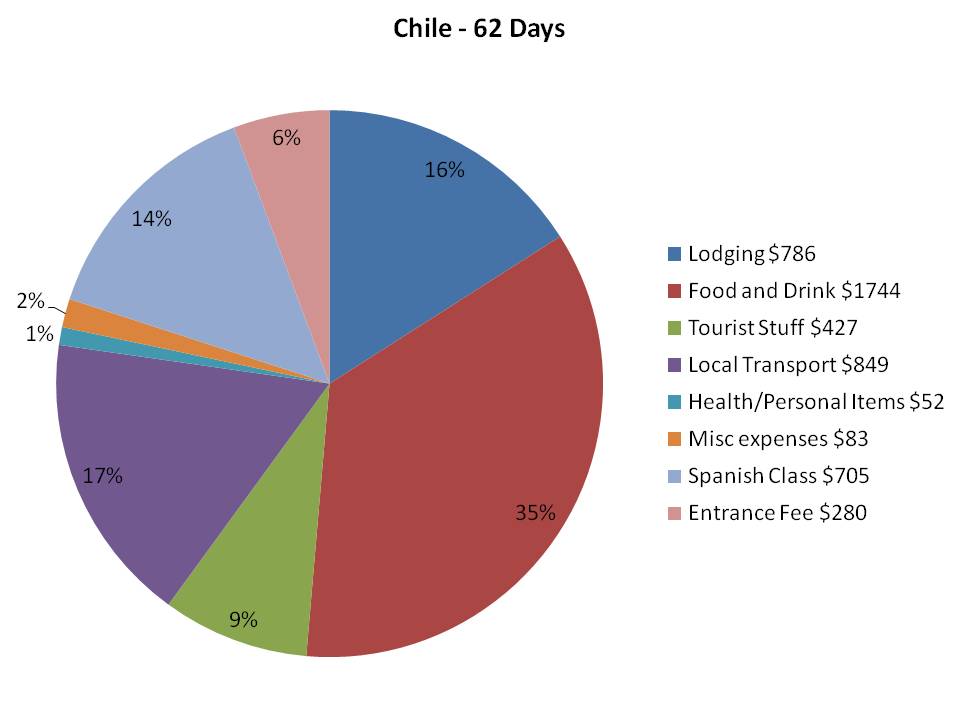
Total US dollar amount spent – $5177

Average cost per day, per person – $42.40

We had 2 big expenses in Chile that really bumped up our spending.

1)      $280 ($140 per person) reciprocity fee for flying into Santiago.  You can avoid this by bussing in.

2)      We took a few weeks of Spanish classes that cost us $705 total.  Chile isn’t the cheapest place to take classes, but it was where we had the apartment and the time to do it, so we think it was very much worth it.  Our Spanish was pretty terrible at the beginning of our trip, and while it’s still not excellent, it’s much improved.  At this point we are able to understand others, and make ourselves understood in most situations, including social situations.  We went to Escuela Bella Vista and were very happy with them.  We had very small classes (the first week was just 3 of us, the second week we had 5 all together) and each week we had 3 different teachers, which was great since each of them had a different style and spoke a little differently.  We’d highly recommend this school if you are in the area and looking for a class.  They can also arrange home-stays and apartments, even for as short as a week, if needed.

Average lodging cost per night – $12.68

*This is a little skewed because for 5 weeks we were fortunate enough to be staying in a friend’s apartment and didn’t incur lodging costs.  If we average the cost for just the 25 days we paid for lodging it ends up being $31.46 per night.  Rooms in Chile are expensive compared to Peru, especially in Patagonia.  In larger towns we’ve managed to find hospedajes where we can have our own room for the same cost as staying in a hostel dorm.  In Patagonia we didn’t have as much luck with this strategy, and as a result we ended up spending most nights in a 6 bunk dorm room.

Most expensive lodging, per person – The Erratic Rock, Puerto Natales, approx $18.50 per night for a shared dorm.   We could have stayed somewhere cheaper, but the Erratic Rock is locally famous for their hearty breakfasts (Omelets! Homemade bread and jam!) and helpful explanations for trekking in Torres Del Paine.

Least expensive lodging per person – Campsite at Refugio Chileno in Torres Del Paine, $9.75 for one campsite with 2 people.

Average food/drink cost per day (per person) – $14.

* In Santiago we predominantly cooked at home, though we did eat out for lunch most days while we were in Spanish School.  We had a few nice dinners out, but generally we found the food in Chile to be ‘meh’.  Most places we’ve stayed in had well-equipped kitchens, which make it easy to stay in and socialize with everyone else who is cooking in.  We drank a LOT in Chile.  We bought a lot of wine and beer at the supermarket, went wine tasting outside of Santiago, and had a few debaucherous nights on the town that really increased the daily average in this category.

The Best

Accommodation

Adolfo’s in Futaleufu.  It’s an actual house complete with a living room furnished with super comfy overstuffed furniture, cable tv and a maid who makes scrambled eggs to order as you sit down to breakfast.  They have a golden retriever named ‘Gringa’, and another scrappy little pup named ‘Pichhu’ who will loyally follow you around town if you are good to him.  A great comfortable place that really feels like home.

Casa Aventura in Valparaiso.  Lonely Planet doesn’t give it a great review, but it was one of the cheaper places we found (for booking online before we went, you can find cheaper if you go and wander around but we were only there for one night and didn’t want the hassle of walking around looking for a place).  They have clearly done some work since the LP review came out and there are sparkling new bathrooms, a nice upstairs lounge area, and huge rooms that are filled with light.  The people who work there were very helpful in giving us a route to walk to see the best of the street art, and the breakfast is good with eggs and fresh fruits.  My personal favorite thing about this place is that THEY RECYCLE!  They have bins set out for paper, cardboard, glass, plastic, and they actually take the time to take it all down to the recycling center.

Food

Tiramisu (Isidora Goyenechea 3141) in Santiago.  Delicious pizzas!  We had great huge salads, real bruschetta, and good wine here.  It’s packed at lunch so be prepared to wait for a table.

I don’t really know what it’s called, but in Niebla, just outside of Valdivia, there is an amazing market of sorts that is filled with vendors selling empanadas by the dozen, grilled meats, fish, steamed clams and mussels, cakes, pastry, and beer.  We stumbled on it randomly while looking for the way to the beach, and were so impressed by the food that we went back…twice!  When you get off the bus in Niebla just walk towards what looks like a marketplace and you’ll run smack into it.

Delicious Express  – Pasaje Galvez 358, just uphill from the Shell station (and just downhill from Casa Aventura) in Valparaiso.  These were easily some of the best empanadas we had in Chile, and they have dozens of fillings to choose from.  They are big and made fresh to order.

Drink – Mote con Huesillo.  So good!  It’s sold at little stands on the streets everywhere.  It’s a food/drink of grain and peaches served in the sweet broth it’s cooked in.  It’s served cold and is both refreshing and a perfect light snack.  The quality varies from place to place, so if your first is sort of ‘meh’, try another one somewhere else.

The Worst

Austral Glacier Travel Agency.  BEWARE!  They are recommended by the Erratic Rock, which we very much liked, so we let our guards down and were blindsided by a huge overcharge for the one thing we let them book for us. They claim they don’t add commission for their bookings, and they came so highly recommended that we didn’t do our due diligence with price-checking before we put the money down, and we didn’t check that they were using the correct exchange rate for the currency conversions from US Dollars to Argentine Pesos to Chilean Pesos.  Stay far, far away from this dishonest place.

Packing List Part 3 – Electronics

19 Feb

Welcome to another installment of the packing list series!  If you haven’t checked them out already, head over to our “Things We Carry” page and check out our first two lists – ‘Clothing’ and ‘Medical and Toiletries’.

It’s the electronic age for sure in the world of nomadic wanderers.  Everywhere we go we see travellers with laptops, ipads, mp3 players of all kinds, smartphones, external hard drives…you get the idea.  We’ve brought along quite the assortment of electronic gadgets and gear, and we use everything regularly.

We’ve had fairly good luck with wifi, though in the smaller towns it’s a bit hit and miss in terms of quality and consistency.  We find that having a laptop with us makes it so much easier to plan our next location, stay in touch with family via Skype, deal with banking without worrying about using a shared computer, and download photos onto our external drive.  We could definitely get by without it, but I find it an easy luxury to justify.

Click on over to check out the full list of our electronic gear.

The End Of The Earth

14 Feb

I don’t remember when we first realized that cruises to Antarctica often leave from Argentina, but as soon as it happened we started researching cost, travel dates and gear we might need to take.  We very quickly realized that the cost was out of our reach, by a lot.

Still, the trip nagged at us.  Every once in a while we’d check out the prices, always hoping something had changed, or that we would find a discount.  Much to our disappointment, nothing ever changed; if anything, the prices actually rose as we got closer to high season.

Then, one day in December while I was wasting time on the interwebs in Santiago, I stumbled across a travel forum where someone had just put up a post about their recent cruise to Antarctica.  As I read through the detailed review, one small comment caught my attention.  The reviewer stated that she was surprised to learn that there were a half-dozen passengers on the boat who had booked last-minute in Ushuaia and had paid substantially less than most people on board.

It didn’t take long before I had tracked down travel agents in Ushuaia who specialize in these last-minute deals.  The problem is that the prices listed on their websites were the same as the ones on the cruise website, so it didn’t seem that there was any discount at all.  I tried in vain to email them, but I never got a response.

We waffled back and forth for weeks about whether we would head down to Ushuaia, a place not really on our itinerary, just to check the situation out.  We hadn’t made any solid decision until very recently when we made it down to the bottom of Patagonia for our planned hiking trip through Torres Del Paine.  While there, we began meeting people who had started their journeys in Ushuaia and were travelling up Chile and Argentina in the opposite direction from us.  Every single one of them told us that all over town there are advertisements for the last-minute cruises.  From what we could tell though, the prices were still much higher than we were hoping.

A few days ago we had to make a decision – head up to Buenos Aires, or head down to Ushuaia.  We decided that if we didn’t at least check it out, we would regret the missed opportunity, so down we went.  As an aside, if you can swing it, fly there.  It took us nearly 30 hours to cover a distance that should have been traveled half that time, and it was easily the worst bus trip we’ve taken so far.

In any case, we dragged ourselves off the bus and into our hostel.  The first thing to greet us upon arrival was a series of fliers touting last-minute Antarctica cruises…for prices that had dropped considerably from the earlier reports we were getting and were even less than the 40% off deals that some companies start to advertise directly on their own websites within a few weeks of unfilled departures.

The next day, which happened to be my birthday, we handed over the credit card and BOOKED A CRUISE TO ANTARCTICA!!!!!  Best. Birthday. Ever.

We leave tomorrow!

We had to sign a waiver agreeing not to tell the other passengers how much we paid.  We’ll give more details at a later date once the trip is over and we are far, far away.

Now, those of you who know me in real life might recall that I have a huge problem with motion-sickness.  I get nauseous on hammocks, and sometimes from movies with too much action.  That is not a joke.  Tragically, to get to Antarctica you have to cross the Drake Passage, which is notorious for having some of the roughest seas in the world.  It is going to take us two days, in each direction, to get through it.

My strategy for making it through alive?  Lots, and lots of pills.  I have close to a hundred motion-sick pills of different varieties, a few sleeping pills (maybe I’ll just sleep through those days…) and the assurance from people who’ve gone before that the sea on the other side is generally calm and enjoyable.

I’ll just have to keep thinking about the icebergs.  The penguins. The whales. The incredible, majestic beauty of this frozen continent.

The Power of Water

9 Feb

We learned of Futaleufu, Chile from a fellow traveler we met in Mendoza.  It didn’t take very long for us to be convinced that this was a place we wanted to visit.  The name alone is reason enough, especially if you say it with a thick French accent.  Go ahead and try it (Foo – TAh – lay –foo), I dare you not to laugh.

We arrived to the minuscule village, just 1700 residents, in the midst of a summer storm that soaked us with freezing rain, and left the surrounding mountain tops dusted in snow. In just under 36 hours the tide had turned and we could see that we had chosen wisely.  Futaleufu is situated in a valley that is truly jaw-dropping.

Valley outside Futaleufu, Chile

Valley outside Futaleufu, Chile

Huge, lush mountains give way to the most spectacularly turquoise blue, crystal clear river I have ever seen.

It’s the river that draws people from around the world to this little dot on a map.  The Rio Futaleufu boasts some of the best rafting and river kayaking in the world, ranking in the top-5 by most accounts.

Rio Futaleufu, Chile

Much of the town’s industry is built around river trips, and it’s an easy task to find a company ready to take you on the ride of your life.  We promptly signed up for a full-day excursion.

We’ve been rafting before, though only minimally on supposed class III and IV rapids, but we were assured that if we were fit and could swim that we would be just fine on the prominent class IV and V runs.

The day we set out on our adventure was bright and warm, a perfect day to get soaked.  We ended up with seven people in our raft – Justin and I, a man from our hospedaje, and 4 other girls (two of which had never been rafting).  We were outfitted with wetsuits, lifejackets, and helmets and given the whole safety spiel.  After a bit of paddle practice at the put-in, we were off!

Justin is ready to go rafting.

The storm had delivered a healthy amount of water to the area making the river swollen and quite high for the season.  The first set of rapids was fast and furious, and we made it through them clumsily, but successfully.

As we approached the next stretch of white-water, a set of three class V+ rapids, appropriately named The Terminator, our guide made it clear that this section was difficult and that we needed to give it everything we had and follow his directions exactly and immediately.  It was essential that we hit our line or we would be in serious trouble.  This section of the river is riddled with ‘holes’, which are basically whirlpools of a sort that can suck you in and just keep you spinning underwater.  These holes can be up to 80 feet deep, and are very dangerous places to get stuck in.

The apprehension was palpable and a few moments later we came around a bend and were all of a sudden right in the thick of it.  It was as if we had no control over the raft.  Sometimes the waves rocked the boat so high that as we went down to paddle there was nothing but air beneath us.  It quickly became clear that we had not made our line and we could see that we were about to hit a huge obstacle in the middle of the river.

My side of the raft got pushed up vertically on a rock as the opposite side got sucked into the hole just in front of the boulder.  I felt myself falling, and had about a hot second to think “Oh shit!” before I hit the river.

The roar of the water was deafening, and the only thing I could see all around me was bubbles. It felt like ages before I broke the surface and was able to take a small breath.  I tried to look for the raft, but there was only water and before I knew it I was going under again.  Have you ever been inside a washing machine on the ‘super’ cycle?  Me neither, but I bet being in that river was similar to what it might feel like.  I was tossed around, sucked along, turned upside down and smashed into rocks.  Despite being more terrified than I have ever been, I made a valiant effort at keeping my feet in front of me and trying to get to the surface but it seemed like I had very little control over my movement.  When I realized I was out of air I did my best not to panic, and just plugged my nose and covered my mouth to try and keep the water from forcing its way in.

Eventually I came to a slightly calmer spot and I was able to see the safety kayaker motioning me to swim over to the side.  I made it to a little pool area and was momentarily relieved thinking that the raft or the kayak must be coming over to fetch me.

I watched uncomfortably as the raft passed me on the opposite side of the river, and my panic increased ten-fold when I realized I was being sucked back towards the middle and into the second part of the Terminator rapid series.  I clawed desperately at the closest rock in a last-ditch effort to stay in calmer waters, but I only accomplished ripping off two of my fingernails.

I remember very little from that second set of rapids, only that I kept thinking “Justin must be freaking out right now” and “keep your mouth shut or you will drown”.

I was in the water for less than ten minutes, but it felt like ages and was so thoroughly exhausting that by the time the raft found me I couldn’t even lift my arms to try and grab onto the safety rope.  The man from our hostel, Celestino, hauled me into the raft by my life vest and I had about 30 seconds to recover before I was handed a new paddle as we entered another set of rapids.

I was still shaking from the adrenaline nearly a half hour later as we went up to shore for a lunch break.  I was nervous and on edge for the rest of the trip, and I was happy to be back on solid ground at the end of the day.

Being in that river was easily the most terrifying moment of my life, and another clear example of the tremendous force that water holds.

Despite the scare, Futaleufu has earned a spot as one of our favorite destinations from this first three months of travel, and if you’re into rafting and gorgeous scenery, we’re sure you’ll love it just as much as we did.

Southern Skies

3 Feb

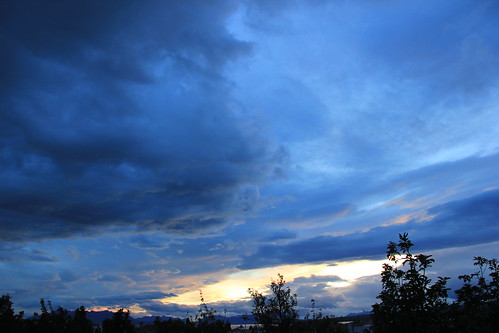
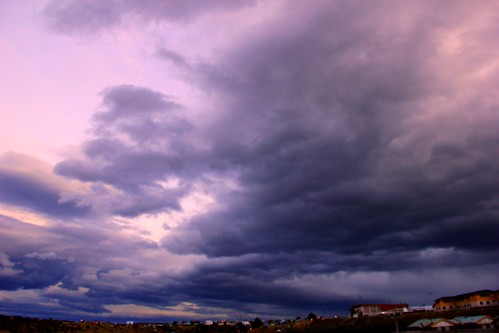
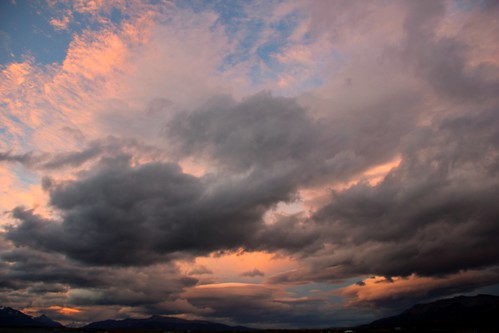
The first thing about we noticed about Puerto Natales, Chile was the sky.  It took us a while to figure out what’s so captivating, but we finally realized that the sky looks bigger somehow than in other places.

We’re pretty sure it has something to do with the clouds.  We’ve never seen anything like it elsewhere, but the clouds here are layered in the most incredible ways and it makes the depth of the atmosphere seem even more expansive than usual.

Our pictures simply do not do it justice.